Deepfake fraud is the use of AI generated video, audio or images to impersonate a real person and steal money, data or access. A few years ago this sounded like science fiction. Today a criminal needs only a short voice clip and a handful of photos to copy your boss, your bank or even your own child.
This guide is the complete answer to “what is deepfake fraud.” You will learn how it works, the main types of deepfake fraud, real cases, deepfake fraud statistics, how to spot a deepfake, how to prevent deepfake fraud and what to do if you become a victim. We also cover deepfake laws, insurance, hiring scams and how penetration testing services help close the gaps that attackers use.
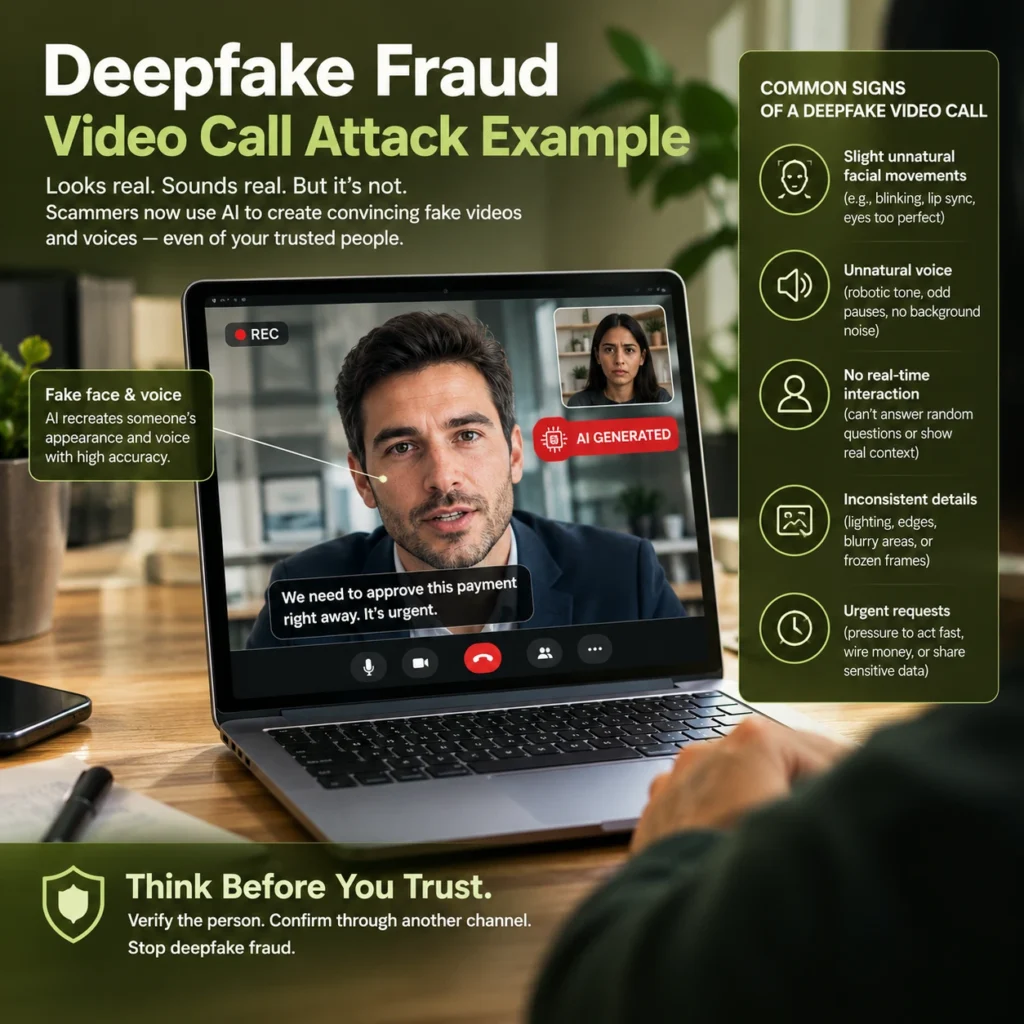
Table of Contents
What Is Deepfake Fraud?
Deepfake fraud is a type of impersonation crime. The attacker uses synthetic media to look or sound like someone you trust, then asks you to act. That action might be a wire transfer, a password reset, a gift card purchase or an identity check approval.
It helps to know the vocabulary. A deepfake is media created or altered by AI. A cheapfake is a simple edit, like slowing a video down, with no AI involved. Synthetic media is the wider term for anything AI makes, including harmless art and marketing content. Deepfake fraud only begins when that media is used to deceive someone for gain.
If you are searching for “what is deepfake” in general, think of it as a fake that looks real. If you are searching for “what is deepfake fraud,” think of it as that fake being used as a weapon.
Why Deepfake Fraud Is Growing in 2026
Three things changed. First, the tools became cheap. Free and low cost apps now do face swaps and voice cloning in minutes. Second, the quality improved. Many fakes now pass casual inspection, especially on a small phone screen. Third, remote work made video calls and voice notes normal, so people are used to approving things without meeting in person.
Add the rise of AI fraud in general, including AI written phishing and fake customer support, and you get an environment where trust is easy to fake. This is why deepfake fraud prevention is now a board level topic and not only an IT task.
How Deepfake Technology Works
Most attacks follow the same path.
Step one is collection. Criminals gather material from social media videos, conference talks, voicemail greetings, podcasts and press interviews. Anything public can become training data.
Step two is generation. Older deepfake technology relied on GANs, which pit two neural networks against each other until the fake looks real. Newer tools use diffusion models and voice cloning software that can work from a few seconds of audio. This is how criminals clone a voice for scams without any special skill.
Step three is delivery. It could be a phone call, a live video meeting, a voice note on a messaging app or a fake selfie sent during onboarding.
Step four is pressure. Scammers add urgency, secrecy and authority so you skip your normal checks.
The technology is only half the story. Deepfake fraud works because it attacks trust and process, not just software
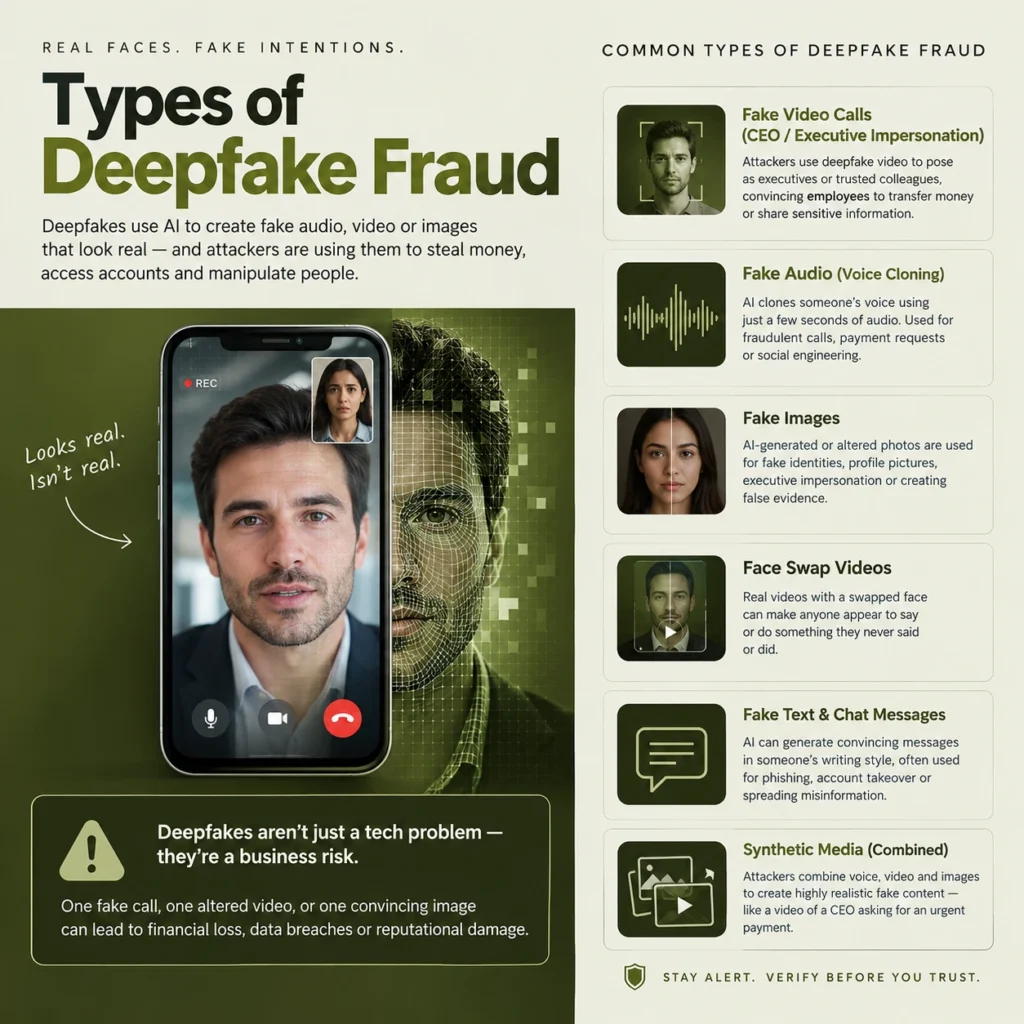
Types of Deepfake Fraud
Deepfake CEO Fraud
An employee sees or hears an executive asking for an urgent payment. This is business email compromise with a face and a voice. Deepfake CEO fraud is the costliest type for companies because the amounts are large and the request looks like it comes from the top.
Voice Cloning Scams
A parent gets a call from a “child” in trouble. A finance manager hears the CFO approving a transfer. A deepfake voice scam is cheap, fast and hard to catch on a poor phone line. Deepfake scams targeting seniors often use this method, with a fake grandchild asking for emergency cash.
KYC and Identity Verification Bypass
Criminals feed fake faces into onboarding checks at banks, fintech apps and crypto exchanges. This is where deepfake KYC fraud meets weak liveness detection. Some attackers even inject fake video straight into the app, so the camera never sees anything real.
Romance, Investment and Crypto Scams
Fake celebrity endorsements and video chats with a “partner” push victims to send money. Deepfake romance scam signs include a person who always has a reason to avoid live video, or a face that looks slightly off when they move. A deepfake crypto scam is especially damaging because transfers are hard to reverse.
Fake Job Candidates
Applicants use face swapping in video interviews to hide who they are and win remote jobs. The deepfake job interview scam is growing fast, and we cover it in detail below.
A Real Case: The Arup Deepfake Scam
If you are wondering how the Arup deepfake scam happened, here is the short version. In early 2024, an employee at the engineering firm Arup in Hong Kong joined a video call with what looked like the company’s CFO and several colleagues. Every other person on the call was fake. The employee made a series of transfers that added up to roughly 25 million US dollars.
The attackers did not hack a server. They used public footage, cloned voices and a convincing meeting. The lesson is simple. Seeing faces on a screen is no longer proof of identity. This case belongs in every list of deepfake fraud in banking case studies, and in every staff training session.
Deepfake Fraud Statistics and Losses
You will find many scary numbers online, and many are recycled from vendor reports with no source. Be careful. When you quote deepfake fraud statistics or deepfake fraud losses for 2026, check three things: who collected the data, how recent it is and whether it counts attempts or confirmed losses.
For reliable figures, start with the FBI Internet Crime Complaint Center annual report and the FTC consumer fraud data. Both show how impersonation scams keep climbing year after year. Treat vendor surveys as direction, not fact.
Deepfake Fraud vs Synthetic Identity Fraud vs Account Takeover
People mix these up, so here is the difference.
Deepfake fraud copies a real person’s face or voice to trick someone in the moment.
Synthetic identity fraud builds a fake person from real and invented data, such as a real ID number with a made up name. A deepfake may be used to pass the selfie check, but the identity itself is fabricated.
Account takeover means the criminal gains control of an existing account, usually through stolen credentials. A deepfake voice call can help them beat a call center check.
Knowing which one you face changes your defense. Deepfake fraud needs verification habits. Synthetic identity fraud needs stronger onboarding. Account takeover needs better access controls.
Real Time Deepfake Video Call Attacks
Most guides talk about edited videos. The bigger risk today is live. Attackers now swap faces and clone voices during a meeting as it happens, so a deepfake video call scam can feel completely normal.
To verify who is on screen, try these checks. Ask the person to turn their head fully to the side. Ask them to pass a hand in front of their face. Ask a question only the real person would know. Then hang up and call back on a number you already have saved.
If a request involves money, never approve it on the call alone. This single rule would have stopped most known cases.
How to Spot a Deepfake: Video Red Flags
Learning how to spot a deepfake starts with knowing the common deepfake red flags.
Blurry edges around the hair, ears or jawline.
Lips that do not match the words.
Odd blinking, or eyes that stare too long.
Lighting on the face that does not match the room.
Glitches when the person moves fast or touches their face.
Skin that looks too smooth, or teeth that look slightly merged.
If you want to know how to detect a deepfake video, watch the edges and the movement, not just the face. Remember that quality improves every month. Red flags help, but process beats instinct.
How to Detect AI Voice Cloning
Voice cloning tells are different, and few websites cover them.
Listen for flat emotion, odd breathing, perfect pauses, a slight robotic echo and no background noise at all. Cloned voices also struggle with interruptions. Talk over them and see how they react. Ask an unexpected question that is not in any script. A real person will answer naturally. A cloned voice driven by an operator may lag or repeat itself.
For families, the best defense is a safe word. Pick a word that is never posted online and use it in any emergency call. This is the simplest way to stop an AI voice scam.
Are Deepfake Detectors Accurate?
Honest answer: sometimes. Detection tools can perform well in lab tests and then fail on new generation methods they have never seen. Compression on a video call can also hide the artifacts that detectors look for. False positives and false negatives both happen.
So do not rely on one tool. Layer your defenses. Liveness detection, which checks that a real person is present in front of the camera, is stronger than image analysis alone. Even then, attackers try injection attacks, which is why a proper test of your onboarding flow matters.
Can deepfakes bypass facial recognition? In poorly built systems, yes. That is a strong reason for banks and fintechs to test their verification pipeline before criminals do.
Best Deepfake Detection Tools and Software
Many buyers search for the best deepfake detection software or deepfake detection tools. Here is what to look for instead of a brand name.
Check whether the tool works in real time or only on uploaded files. Ask for independent test results, not just a vendor demo. Look for a deepfake detection API if you need to plug it into your app or call center. Confirm it supports both video and voice. Ask how often the models are updated, because attackers change methods quickly.
Also compare liveness detection vs deepfake detection. Liveness checks the person in front of the camera. Deepfake detection analyzes the media itself. Strong systems use both, and then add human review for high risk cases.
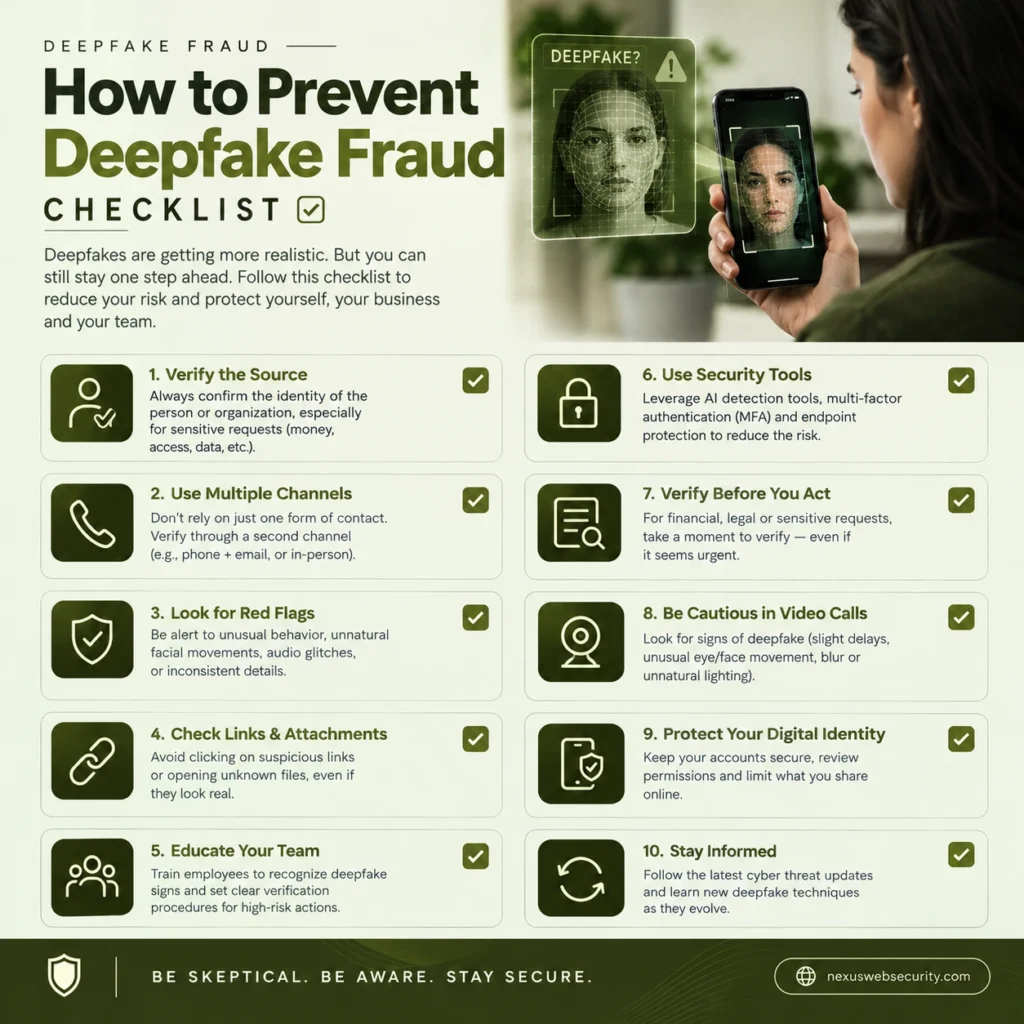
12 Proven Ways to Prevent Deepfake Fraud
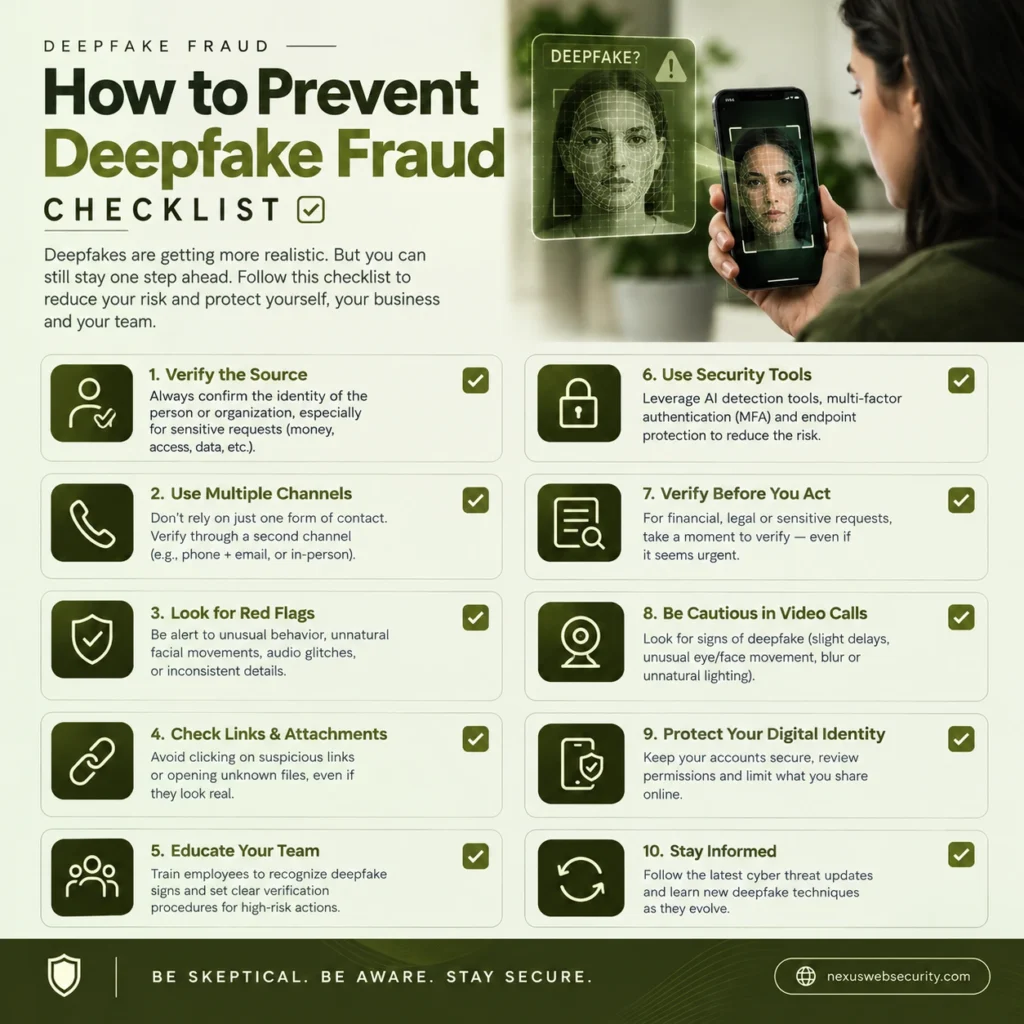
If you want to know how to prevent deepfake fraud, start with these twelve steps.
- Use a callback rule. Confirm any payment or credential request on a known number.
- Require two approvals for transfers above a set amount.
- Create family and team safe words for emergencies.
- Never approve money on a video call alone.
- Turn on multifactor authentication everywhere, preferably with hardware keys.
- Run employee training for deepfake awareness with real examples, not generic slides.
- Limit the public audio and video of executives where you can.
- Write a short deepfake fraud policy for your business, even if you are small.
- Use liveness detection in customer onboarding.
- Log and review unusual payment requests every week.
- Run phishing and voice scam drills, then share what you learn.
- Test your defenses with VAPT services so weaknesses are found before attackers find them.
For small businesses, the policy in step 8 can fit on one page. Name who can approve payments, which channels count as verified and what staff should do when something feels off. The CISA website has free guidance on social engineering that you can adapt.
Deepfake Fraud Prevention for Banks and Fintechs
Deepfake detection for banks needs more than a single tool. Call centers should use voice authentication with extra questions, not voice alone. Onboarding should combine document checks, liveness detection and device signals. Large transfers should trigger a manual review, no matter how real the customer looks or sounds.
Banks should also build deepfake KYC fraud scenarios into their risk models and review them every quarter. A pentest for banks that covers mobile apps, APIs and onboarding flows shows where a fake face or voice could slip through.
Deepfake Fraud in Hiring
Remote hiring has opened a new door. Some applicants use a stolen identity and a face swap during interviews. Some are tied to organized schemes to get paid IT jobs and access to company systems.
HR teams can protect themselves. Ask candidates to do a live task on camera. Verify ID documents with a trusted provider. Compare the person on interview day to the person on day one. Limit system access during the first weeks. Share these rules with recruiters and hiring managers, not just IT.
Penetration Testing and Deepfake Fraud
Deepfakes are a people problem, but they succeed because of technical gaps. A criminal who clones your CFO’s voice still needs a path into your approval system, email or identity checks. That is where penetration testing comes in.
A proper penetration testing engagement looks at how an attacker could chain small weaknesses together. A full vulnerability assessment and penetration testing program covers network penetration testing, cloud penetration testing, mobile apps, API security testing and web application penetration testing. Guidance from OWASP is widely used to cover the most common web risks, and the NIST framework helps you structure your security program.
For deepfake fraud, ask your provider to include social engineering penetration testing and a red team assessment. These simulate voice phishing, fake executive requests and weak help desk verification. The results show you exactly where your staff and systems would fail.
Banks and fintechs should also test onboarding and KYC flows for injection and bypass attacks. Our penetration testing services team works with organizations that want this kind of realistic testing before an incident, not after.
Does Insurance Cover Deepfake Fraud?
Often, not clearly. Many cyber insurance policies cover data breaches but treat fraudulent payments made by a tricked employee as a separate item. Social engineering and funds transfer coverage is often an add on with its own limits, so deepfake fraud insurance coverage varies widely.
Ask your broker three questions. Does the policy cover deepfake impersonation specifically? Is there a sublimit for social engineering? Does the insurer require callback procedures before they pay? Many do, and skipping them can void a claim.
Deepfake Laws Around the World
The law is catching up unevenly. If you are searching for deepfake laws 2026 or deepfake legislation by state, use this as a starting map and then confirm locally.
United States: there is no single deepfake fraud law, but fraud, wire fraud and identity theft statutes apply. The TAKE IT DOWN Act deals with intimate deepfakes, and many states have added their own rules on election and impersonation deepfakes.
European Union: the EU AI Act introduces transparency duties, including labeling of AI generated content. Check the current timeline, since provisions phase in over time.
United Kingdom: the Online Safety Act and existing fraud law cover parts of the problem.
UAE and the wider Middle East: cybercrime and impersonation rules apply, and regulators are paying close attention to AI misuse. Always check with local counsel.
India and Singapore are also tightening rules on AI generated deception. Because laws change fast, treat this section as guidance, not legal advice.
Content Provenance and Watermarking
One promising defense is proving where media came from instead of trying to prove it is fake. The C2PA standard attaches signed information to files that shows how they were created and edited. Watermarking adds hidden signals to AI output.
Both help, but neither is perfect. Metadata can be stripped, and bad actors will not use tools that label their output. Think of provenance as one layer, not a cure.
What to Do If You Are a Victim of Deepfake Fraud
Move fast. The first 24 hours matter most. If you need to report a deepfake scam or ask about a deepfake scam refund, follow these steps.
- Call your bank right away and ask for a recall or freeze on the transfer.
- Save everything: call logs, recordings, screenshots, emails and wallet addresses.
- Report to the police and to your national fraud center. In the US, file with the FBI Internet Crime Complaint Centerand the FTC.
- Report the content to the platform where it was hosted.
- Change passwords and secure affected accounts.
- Notify your insurer and, for businesses, your legal team.
- Warn colleagues, since the same attacker may try again.
Refunds are never guaranteed, but speed raises the odds.
FAQ
What is deepfake fraud?
Deepfake fraud is the use of AI generated video, audio or images to impersonate someone and trick victims into sending money, sharing data or granting access.
How do scammers use deepfakes?
They clone voices for phone scams, fake executives on video calls, bypass identity checks and impersonate celebrities in investment ads.
Can deepfakes be used to steal money?
Yes. Deepfake fraud has already led to multimillion dollar transfers, as the Arup case shows.
Can AI clone my voice from a few seconds of audio?
Yes, modern tools can create a convincing copy from very short samples, which is why safe words and callbacks matter.
How can you tell if a video call is a deepfake?
Ask for a side turn and a hand wave, watch for lip sync problems and verify through a second channel.
Is creating a deepfake illegal?
It depends on the purpose and location. Using one to defraud, harass or impersonate is illegal in most places.
What is the biggest deepfake scam ever?
The Arup case, at roughly 25 million US dollars, is one of the largest publicly reported. Verify current figures before quoting them.
Can deepfakes bypass bank facial recognition?
Weak systems can be fooled. Strong liveness checks and regular security testing reduce the risk.
What is the difference between deepfake fraud and phishing?
Phishing usually uses text based messages. Deepfake fraud adds a fake face or voice, which makes it feel far more real.
Are deepfake detectors accurate?
They help but are not foolproof. Use them together with process controls.
Does insurance cover deepfake fraud?
Only if your policy includes social engineering coverage. Read the terms carefully.
What should I do if I am scammed by a deepfake?
Contact your bank, save evidence, report to authorities and secure your accounts.
How can businesses protect employees from deepfake CEO scams?
Use callbacks, dual approvals, regular training and security testing of your approval systems.
Final Thoughts
Deepfake fraud will keep getting more convincing, but it is not unstoppable. The strongest defenses are boring ones: callbacks, two approvals, safe words, trained people and tested systems. Build those habits now, and a fake face on a screen loses most of its power.
Worried your business could be the next target of deepfake fraud? Find out where your people, processes and systems are exposed. Book a consultation with Nexus Web Security and get a tailored VAPT services plan, including social engineering testing and a red team assessment, before attackers do it for you. Contact our team today.