

Published 31 October 2026. Figures are based on reports available at the time and may change.
The Binance hack is now the largest cryptocurrency theft on record. Attackers drained about $6.3 billion from the exchange’s hot wallets on 29 October 2026, according to Binance. Blockchain analytics firm TRM Labs puts the total at about $6.36 billion. About $3 billion has been frozen, and Binance says it will cover all losses.
This article collects the confirmed data, separates facts from speculation and explains what businesses can learn from it.
Table of Contents
Binance Hack: Key Facts at a Glance
| Item | What reports say |
|---|---|
| Date | 29 October 2026 (evening US time) |
| Amount stolen | About $6.3 billion (Binance); $6.36 billion (TRM Labs) |
| Speed | Roughly 20 minutes, across ten blockchains |
| Frozen so far | About $3 billion (Binance); about $2.8 billion (Chainalysis) |
| Stablecoin freezes | Tether froze nearly $1.57 billion; Circle froze hundreds of millions |
| Who pays | Binance, through its SAFU fund and company reserves |
| Suspected attacker | North Korea’s TraderTraitor group (TRM Labs and Chainalysis, high confidence) |
| Withdrawals | Paused; Binance expects a phased restart. Deposits are working |
| Binance.US | Not affected |
Early viral posts said “over $5.6 billion”. That was an early count. The figure rose as analysts traced more wallets.
What Happened in the Binance Hack
On the evening of 29 October, a user noticed more than $2.7 billion in assets moving out of a Binance wallet to an external account. Binance then suspended deposits and withdrawals. Binance confirmed the theft later that night and said the estimated total impact was about $6.3 billion.
Co-founder Changpeng Zhao wrote that it did look like a hack. Tether’s CEO said his company had frozen more than $1.56 billion linked to the incident. Binance later said about $3 billion of the stolen assets had been identified and frozen.
According to TRM Labs’ analysis of the Binance hack, the attacker moved funds out of ten blockchains in about 20 minutes. Dozens of tokens were affected, including Bitcoin, Ether, Tron and the stablecoins USDT and USDC.
How Did the Binance Hack Happen?
Binance has not published a final root cause. Here is what it has said so far:
- Initial finding: the incident may involve a compromised DevOps engineer’s laptop, which let an attacker reach a service container and submit unauthorized withdrawals, as The Hacker News reported on the Binance breach.
- Update: investigators found “additional points of breach” beyond the laptop.
- Keys: Binance said it found no evidence that private wallet keys were leaked.
- TRM view: evidence points to compromise of the hot wallet signing infrastructure.
Some analysts have also pointed to a newer Ethereum feature, EIP-7702, as a possible way around security checks. This is a theory under investigation and is not confirmed.
Who Is Behind the Binance Hack?
Two major tracing firms blame North Korea. Chainalysis attributes the hack to TraderTraitor after it watched Binance’s stolen funds mix on-chain with funds from last month’s Bitget theft, which was also linked to North Korea. TRM Labs reached the same conclusion with high confidence.
The same group was blamed by the FBI for the $1.5 billion Bybit theft in February 2025. CNN reported that the US Secret Service is working with Circle to trace and freeze funds. In the reports we reviewed, no government had yet formally announced attribution for this case.
How the Binance Hack Moved Markets
Markets reacted within hours. CoinDesk’s market coverage and other outlets reported these moves:
- Bitcoin fell more than 3% to a six-week low near $76,400.
- Ether dropped more than 3% to a two-month low near $2,178.
- BNB, Binance’s token, slid roughly 8%.
- Coinbase shares fell 4.8%, and Strategy fell nearly 6% in after-hours trading.
One market-data report counted about $1.57 billion in liquidations during the sell-off.
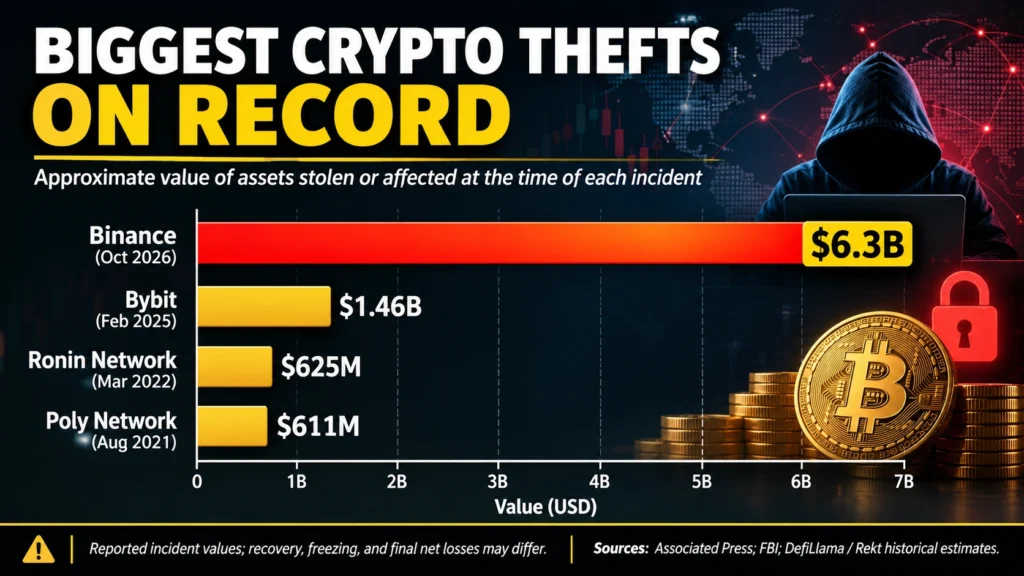
Biggest Crypto Hacks Compared
| Rank | Incident | Year | Amount stolen |
|---|---|---|---|
| 1 | Binance | 2026 | About $6.3 billion |
| 2 | Bybit | 2025 | About $1.5 billion |
| 3 | Ronin Network | 2022 | About $615 million |
| 4 | Poly Network | 2021 | About $611 million |
The Binance hack is about four times larger than Bybit. Chainalysis counted more than $3.4 billion stolen in all of 2025, while TRM counted $2.87 billion in nearly 150 incidents. Either way, this one theft is almost twice the full-year 2025 total.
Are User Funds Safe After the Binance Hack?
Binance says yes. It says user funds are safe and that it will absorb the loss. Its recovery plan includes:
- $6.34 billion reserved from the SAFU fund (about $1 billion in bitcoin) and company funds.
- About $5 billion held in the same assets that were stolen, covering roughly 80% of the loss. Binance is buying the remaining 20% on the market and over the counter.
- An updated proof of reserves once remediation is finished.
- Phased withdrawals, subject to completed security checks.
The cover depends on Binance’s own finances and execution. Watch for the proof-of-reserves report. If you hold funds on any exchange, use only Binance’s official channels for updates. This is general information, not financial advice.
Expect scams. Fake “recovery” and “compensation” messages usually follow a major hack. Never share seed phrases or click links in unsolicited messages.
Why Exchanges Are Prime Targets for Hackers
Centralized exchanges keep huge pools of assets in hot wallets, which must stay online to process withdrawals. That makes them a rich, always-on target. Attackers need only one weak point, while defenders must secure everything.
Criminals now use hacker AI tools to scan for exposed services and write convincing phishing messages. A single unethical hacker with automation can probe thousands of systems. State-backed groups add patience and funding, staging attacks for weeks before moving funds in minutes.
The answer is not fear but practice. Ethical hacking turns the attacker’s playbook into a defense. Certified ethical hacker (CEH) professionals and a well-run bug bounty program help find flaws before criminals do.
Related Attacks: Bitget, GMO and Bank Cyberattacks
The Binance hack did not happen in a vacuum. Bitget lost about $351.6 million in September, and Chainalysis saw funds from that theft mix with the Binance loot.
In Japan, GMO Internet refused a $50 million ransom demand after a cloud service breach. That case shows why ransomware recovery services and offline backups matter for every firm. Meanwhile, AI-assisted intrusions have hit financial firms in South Korea and Latin America.
Together these cases show a pattern. Attackers target the systems that move money, and they target people first.
Security Lessons From the Binance Hack
The two largest exchange thefts in history, Bybit and Binance, both reportedly began with a compromised staff computer. Attackers did not need to break cryptography. They went after people, laptops and internal services. Here is what exchanges, fintechs and any business handling money should take from it:
- Treat developer machines as high-value targets. Lock down endpoints, limit admin rights and monitor for unusual access.
- Limit what internal services can do. A single container should never be able to approve large withdrawals alone.
- Add independent approval and speed limits. Large transfers need multiple approvals, out-of-band checks and automatic stops.
- Watch outflows in real time. Alerts should fire when unusual volumes leave hot wallets.
- Test the full attack path. A red team exercise can show how an attacker moves from a laptop to a payment system.
- Run regular penetration testing. Web application penetration testing, external penetration testing and internal infrastructure penetration testing find the gaps between systems before criminals do.
- Review cloud and pipeline access. A security audit should cover CI/CD, secrets and service permissions.
Penetration testing finds exploitable flaws by simulating real attackers, and combining it with a vulnerability assessment gives you VAPT services coverage across apps, APIs and infrastructure. For banks, exchanges and fintechs, bank penetration testing should also cover payment flows and approval workflows.
Security Controls Every Exchange Needs After the Binance Hack
The Binance hack shows that security failures are rarely about one broken lock. They are about how many doors lead to the same vault. These controls close the most common gaps.
Secure Developer Endpoints and Secrets
Adopt zero trust security so no device or service is trusted by default. Require multi-factor authentication, use hardware keys for administrators and keep secrets in a managed vault. Anti-phishing software and staff training protect the people attackers target first. Add DevSecOps penetration testing to your build pipeline so new code is checked before release.
Harden Containers and Cloud Services
The reported entry point was a service container, so container security best practices matter. Scan images, remove excess permissions and isolate workloads. Kubernetes security should include role-based access control and network policies. Follow cloud-native security practices, and order a cloud security assessment to review accounts and identities. Smaller teams can use managed cloud security services.
Protect Withdrawal and Signing Systems
Withdrawal approval should never depend on one machine. Use multi-party approval, hardware-protected signing, address allow-lists and hard limits on outflows. API security matters here too, so test every endpoint that can start a transfer.
Detect Attacks Faster
AI threat detection and network security monitoring can flag unusual activity in minutes. Threat intelligence tools and a threat intelligence analyst help you track groups such as TraderTraitor. If you lack staff, managed SIEM or SOC as a service gives round-the-clock coverage. SOC stands for security operations center, the team whose analysts review alerts and respond.
Penetration Testing for Exchanges After the Binance Hack
Why penetration testing is important is clear here. It shows how a real attacker would chain a laptop, a container and a signing service. Plan the penetration testing scope to include the full withdrawal path, and use a third party penetration test to remove internal bias.
Cover web application penetration testing, external penetration testing and internal infrastructure penetration testing. Add a penetration test web application check for every admin panel. A red team exercise shows how fast an attacker can move between systems. Automated penetration testing and a continuous pentest keep coverage between manual tests, and compliance pentesting provides evidence for regulators.
How often should penetration testing be done? At least annually and after major changes. Penetration testing quotes depend on scope, so share a clear pentest plan when you ask for them. For financial firms, bank penetration testing should also cover payment flows.
Prepare for the Worst
Run a security risk assessment and schedule a regular security audit. Protect customer data with data privacy solutions. Write an incident response plan and rehearse it. Cybersecurity as a service can fill gaps for lean teams.
Binance Hack FAQs
How much was stolen in the Binance hack?
Binance estimates about $6.3 billion. TRM Labs counts about $6.36 billion. Early reports said $5.6 billion, and some analysts cited lower figures before tracing was complete.
Who hacked Binance?
TRM Labs and Chainalysis attribute it to North Korea’s TraderTraitor group with high confidence. No formal government attribution had been announced in the reports we reviewed.
How did the Binance hack happen?
Binance says an attacker may have used a compromised DevOps engineer’s laptop to reach a service container and submit unauthorized withdrawals. Its investigation has since found additional points of breach, and a final root cause has not been published.
Is my money safe on Binance?
Binance says user funds are safe and that it will cover all losses. It plans to publish an updated proof of reserves. Check its official channels for current status.
Can the stolen funds be recovered?
About $3 billion has been frozen with help from Tether, Circle and tracing firms. The rest may be laundered, and past North Korea-linked cases show that recovery is often partial.
Was Binance.US affected?
No. Binance.US said the incident did not affect its platform.
How can businesses prevent a hack like this?
Secure staff endpoints, restrict service permissions, require multi-party approval for large transfers, monitor outflows and test your defenses with regular penetration testing.
What is a hot wallet?
A hot wallet is connected to the internet so an exchange can process deposits and withdrawals quickly. It is convenient, but easier to attack than offline cold storage.
What is Binance’s SAFU fund?
SAFU stands for Secure Asset Fund for Users. It is an emergency reserve created in 2018 to cover losses from security incidents, and it held roughly $1 billion in bitcoin before this event.
Could penetration testing have prevented the Binance hack?
No test can promise that. But regular testing of endpoints, containers and withdrawal systems finds the chained weaknesses attackers use, and it lowers the odds of a successful breach.
Is Your Business Next? Test Your Defenses First
The Binance hack shows that one weak link can cost billions. Do not wait for an incident to learn where your gaps are.
Get a penetration test built for finance and fintech. Book a VAPT assessment with Nexus Web Security and receive a prioritized report covering your web apps, APIs, cloud and internal systems.