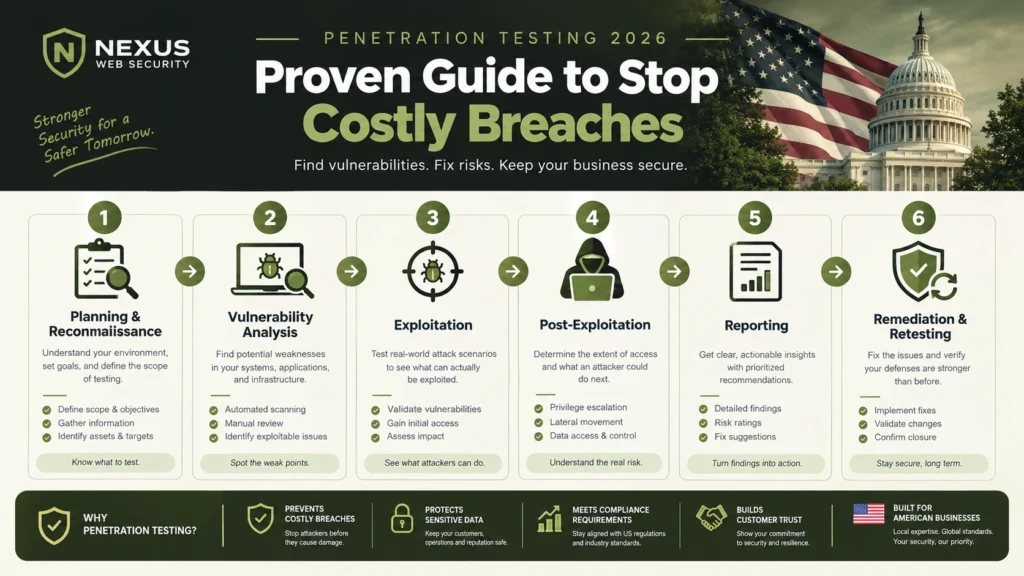
Penetration testing is the most reliable way to learn how a real attacker would break into your business, before a real attacker tries. In a penetration testing engagement, ethical hackers safely exploit weaknesses in your websites, networks, APIs and cloud systems. Then they hand you a prioritized plan to fix them.
This pillar guide explains what a pentest is, which types exist, how the methodology works, what tools testers use, what it costs and how to choose a partner. Whether you are a founder, an IT manager or a student, you will leave with a clear plan.
Table of Contents
What Is Penetration Testing?
Penetration testing, also called pen testing or pentesting, is an authorized, simulated cyberattack on a system, application or network. Its goal is to prove which vulnerabilities are truly exploitable and how much damage they could cause.
A pentest blends automated tools with human creativity. A tester chains small flaws, such as a weak password, a misconfigured server and a missing patch, into a path that reaches sensitive data. That is why penetration testing in software testing and security programs is treated as the “proof” step. It turns theoretical risk into evidence.
If you are new to the topic, here is penetration testing 101 in four terms:
- Scope: the systems, IP ranges and applications the tester may attack.
- Rules of engagement: the legal limits, testing windows and contacts.
- Exploit: a technique that turns a weakness into real access.
- Remediation: the fix, followed by a retest to confirm it worked.
Why Pen Testing Matters in 2026
Why penetration testing is important comes down to money, trust and speed. Attackers now use automation and AI to find exposed systems within hours. According to IBM’s Cost of a Data Breach report, the average US breach cost about $10.22 million in 2025.
A single pentest costs a fraction of that. Here is what you gain:
- Real risk visibility: you see exploitable paths, not just long lists of warnings.
- Smarter budgets: findings show where security spending actually reduces risk.
- Customer trust: a clean report helps win enterprise deals and security questionnaires.
- Compliance proof: auditors ask for evidence, and a pentest provides it.
Pen Test vs Vulnerability Assessment vs VAPT
These terms are often mixed up. A vulnerability assessment finds and ranks known weaknesses, usually with scanners. A pen test goes further by exploiting them manually. Combining both is called VAPT services (Vulnerability Assessment and Penetration Testing).
| Approach | What it does | Best for |
|---|---|---|
| Automated scan | Finds known issues quickly | Weekly hygiene checks |
| Vulnerability assessment | Finds and ranks weaknesses | Broad coverage |
| Pen test | Exploits weaknesses manually | Proving real impact |
| VAPT | Combines both in one report | Most businesses |
Think of a home inspection. A scan checks that the doors exist. A pentest tries to pick the lock.
Types of Penetration Testing
Each type targets a different attack surface. Most organizations need more than one.
Web Application Penetration Testing
This service examines logins, forms, APIs and business logic for flaws such as injection and broken access control. Testers usually follow the OWASP Top 10 and the web application penetration testing methodology published in the OWASP Web Security Testing Guide. It is the most requested service because websites are the most exposed assets.
External Penetration Testing
This test attacks what the internet can see: public IPs, VPNs, mail servers and cloud services. It answers one question. Can an outsider get in? Every business with an online presence needs this one.
Internal Infrastructure Penetration Testing
This test assumes an attacker already has a foothold, such as a phished laptop. Testers try to move across the network, escalate privileges and reach crown-jewel data. In the internal vs external pen testing debate, you should run both because they answer different questions.
Network, Wireless, Cloud and API Testing
Modern environments span offices, remote workers and cloud platforms. Network testing, wireless testing, cloud configuration reviews and API testing close those gaps. Remote penetration testing makes this practical for distributed teams.
Social Engineering and Red Team Exercise
A red team exercise simulates a determined adversary over weeks. It blends phishing, physical access and technical attacks. It tests your people and your detection team, not only your code.
Automated Pentesting and Continuous Pentest
Automated penetration testing platforms run attack simulations on a schedule. A continuous pentest model keeps coverage between annual manual tests. Automation is useful, but it cannot replace human judgment on complex logic flaws.
Black Box, White Box and Gray Box Testing
The testing style depends on how much information you give the tester.
- Black box: no inside knowledge. It mimics an outside attacker.
- White box: full access to code, diagrams and credentials. It gives the deepest coverage.
- Gray box: partial knowledge, such as a normal user account. It balances realism and efficiency.
For most web projects, gray box testing delivers the best value per dollar.
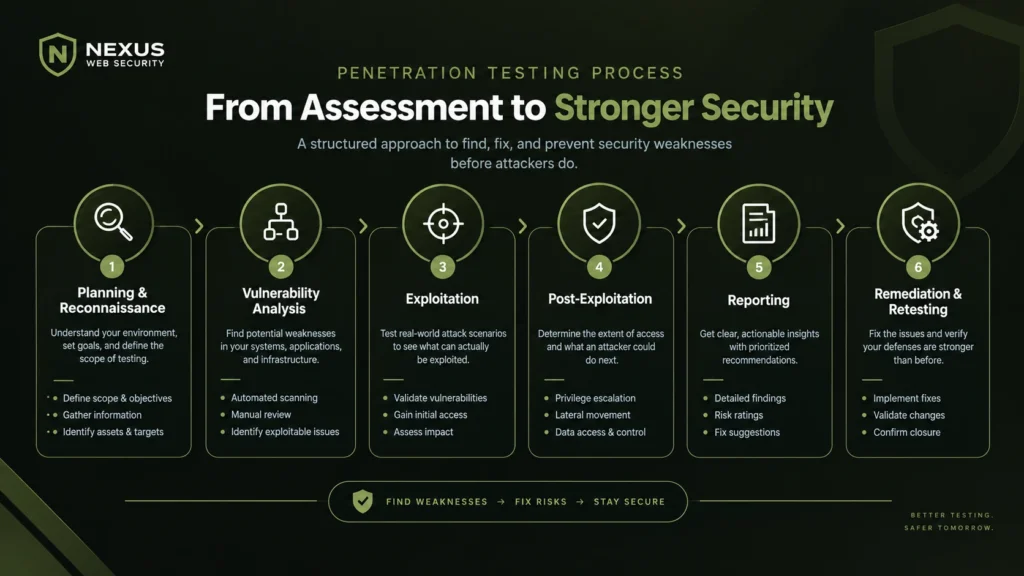
The Penetration Testing Methodology: 5 Phases
A mature pentest life cycle follows a repeatable process. Standards such as NIST SP 800-115 and the PTES pentesting methodology describe the same core flow.
1. Planning and Scoping
Define the penetration testing scope, goals, timeline and rules of engagement. A written pentest plan protects both sides legally and avoids accidental downtime.
2. Reconnaissance
Testers gather public information about your domains, staff, technologies and leaked credentials. Good reconnaissance often reveals the easiest way in.
3. Scanning and Enumeration
Tools map open ports, services and software versions. This is where scanners help, and where testers start choosing targets.
4. Exploitation
Testers safely exploit vulnerabilities to gain access, escalate privileges and demonstrate impact. Many teams map these tactics to the MITRE ATT&CK framework so defenders can improve detection.
5. Reporting and Remediation
The final phase delivers findings, proof and fixes. After your team patches issues, a retest confirms they are closed.
Pentesting Tools Ethical Hackers Use
Professional pentesters rely on a proven toolkit:
- Nmap for network discovery and port scanning.
- Burp Suite for intercepting and testing web traffic.
- Metasploit for controlled exploitation.
- Kali Linux as the standard testing operating system.
- OWASP ZAP for open-source web scanning.
Tools do not make a tester. Skills do. Look for professionals holding credentials such as Certified Ethical Hacker (CEH), OSCP or CompTIA PenTest+. Ethical hacking certifications show training, but real project experience matters more.
How Much Does Penetration Testing Cost?
Prices vary widely, so be careful with any fixed number you see online. Reliable penetration testing quotes depend on these factors:
- Size of scope: number of applications, IPs, user roles and API endpoints.
- Depth: black box, gray box or white box effort.
- Complexity: custom business logic costs more to test than a brochure site.
- Compliance needs: formal attestation letters add reporting work.
- Retesting: some providers include one free retest, others charge for it.
Ask every vendor for a scoped, fixed-price proposal. Beware of suspiciously cheap offers. They often repackage an automated scan as a pentest.
How Long Does a Penetration Test Take, and How Often?
How long does a penetration test take? Small web applications usually need one to two weeks. Larger networks or multi-application projects can take several weeks, plus reporting time.
How often should penetration testing be done? Aim for at least once a year. Also test after major releases, infrastructure changes or acquisitions. Teams practicing DevSecOps penetration testing add smaller tests to every sprint and keep a deeper manual test for each quarter.
Pen Testing for Compliance
Many frameworks require or strongly expect regular testing:
- PCI DSS: requires internal and external pen tests for systems handling card data.
- HIPAA Security Rule: expects regular technical evaluation of safeguards for patient data.
- SOC 2 and ISO 27001: auditors commonly request pentest evidence.
- Financial sector: bank penetration testing is standard to protect payment and customer systems.
Compliance penetration testing should map each finding to the control it supports. That saves time at audit.
What a Pentest Report Should Include
The report is the real deliverable. A strong one contains:
- An executive summary written for non-technical leaders.
- A clear risk rating for every finding, ideally using CVSS.
- Step-by-step proof of concept so developers can reproduce the issue.
- Practical remediation advice, not generic warnings.
- A retest section confirming what was fixed.
Ask vendors for a sanitized sample. Customizable pentest reporting templates are a good sign of process maturity.
How to Choose a Penetration Testing Company
Use this short checklist when comparing providers:
- Do testers hold recognized certifications and real case experience?
- Is the work manual-first, with tools as support?
- Will you receive a free retest and developer-friendly report?
- Does the provider sign an NDA and define rules of engagement?
- Is the team independent? A third party penetration test removes internal bias.
If you want a team that combines scanning with hands-on exploitation, explore Nexus Web Security’s penetration testing services.
Ethical Hacking Explained: Meaning, Skills and Certification
The meaning of ethical hacking is simple: skilled, authorized people use attacker techniques to improve security. An unethical hacker does the same without permission. Ethical hacking in enterprise data environments covers databases, file shares and cloud storage as well as websites.
New to the field? A step by step guide to ethical hacking for beginners starts with networking, Linux, web basics and legal rules. A typical ethical hacking syllabus then adds reconnaissance, exploitation and reporting.
If you want to get ethical hacking certified, compare the Certified Ethical Hacker (CEH) path with hands-on exams. Reading the pentest exam objectives for each one helps you plan your study time.
Risks, Remediation and Security Audits
The importance of penetration testing is clear, but good planning keeps the downsides small. Penetration testing risks include brief slowdowns or locked accounts, so agree on testing windows and a rollback plan first.
Fixing issues matters more than finding them. Penetration testing remediation should start with critical flaws. Application security testing remediation should include code changes plus a retest.
For security testing in web applications, combine web application penetration with secure code review. Penetration testing web application projects often start with login and payment flows. If you pentest web application features, confirm authorization checks for every role. A penetration test web application report should list each vulnerable endpoint.
Scope can also cover your wider stack. Infrastructure penetration testing and pentesting network devices protect servers, firewalls and VPNs. An application-based penetration test focuses on one product. Smaller firms can buy internal pentesting services or remote pentesting on a monthly plan.
Finally, connect testing to governance. Compliance pentesting supports a cyber security audit. Buyers often compare security audit companies and vulnerability assessment pricing side by side. Review OWASP top 10 providers carefully, and read each vendor’s penetration testing vs traditional security methods explained page. The best bug bounty program can then complement your regular tests.
How to Prepare for a Pentest
A little preparation makes every engagement faster and cheaper. Before your penetration testing kickoff call, complete these five steps:
- Inventory your assets: list domains, applications, servers and cloud accounts.
- Set clear goals: decide whether you need compliance proof, a customer assurance report or a deep technical review.
- Prepare test accounts: create users for each role, such as admin, staff and customer.
- Take backups: confirm you can restore quickly if something unexpected happens.
- Brief your team: tell developers and support staff when testing starts, so no one mistakes it for a real incident.
Common Misconceptions to Avoid
These penetration testing misconceptions waste budgets every year:
- “A vulnerability scan is enough.” Scans miss logic flaws and chained attacks.
- “We are too small to be a target.” Automated attacks hit every exposed system.
- “Once a year is forever.” Every new release can add new risk.
- “Passing a pentest means we are secure.” It shows security at one moment in time.
Pair testing with other controls such as patching, MFA and a security audit program, and consider a bug bounty program once your basics are solid.
Penetration Testing FAQs
What is a pen test in simple words?
It is a safe, authorized hacking exercise. Experts try to break into your systems, then explain how to fix the weak points.
What is the difference between a pen test and a vulnerability scan?
A scan lists known weaknesses automatically. A pentest exploits them manually to prove real impact and uncover logic flaws.
How often should penetration testing be done?
At least annually, and after major changes to applications or infrastructure.
Is pentesting legal?
Yes, when you give written permission and agree on scope. Testing systems you do not own is illegal.
Does pentesting cause downtime?
Rarely. Professional testers use safe techniques and agreed windows to reduce risk to production systems.
Is pen testing the same as ethical hacking?
They overlap. Ethical hacking is the broader mindset, while a pentest is a structured, scoped engagement with a formal report.
Conclusion: Start Penetration Testing Before Attackers Do
Pentesting turns security from guesswork into evidence. It shows what attackers can reach, what it would cost you and what to fix first. Start with a clear scope, choose an experienced team and retest after every fix.
Ready to find your weak points first? Book a VAPT assessment with Nexus Web Security and get a prioritized, developer-ready report.