Vulnerability visibility is the ability to see every asset, weakness and exposure across your environment before an attacker does. It is the foundation of cyber risk reduction. You can’t reduce risk you can’t see, and you can’t fix a weakness you don’t know exists.
Most breaches don’t begin with a brilliant zero-day. They begin with a forgotten server, an unpatched internet-facing system, or a cloud service nobody owns. This guide explains why vulnerability visibility matters in 2026 and why seeing isn’t enough on its own. It also gives you seven steps to build it, including how penetration testing and a structured security risk assessment close the gaps that scanners miss.
Table of Contents
What Is Vulnerability Visibility?
Vulnerability visibility means knowing three things at any moment:
- What you own: every device, application, API, cloud workload and domain.
- What’s weak: the vulnerabilities and misconfigurations on each asset.
- What matters: which weaknesses attackers can actually reach and exploit.
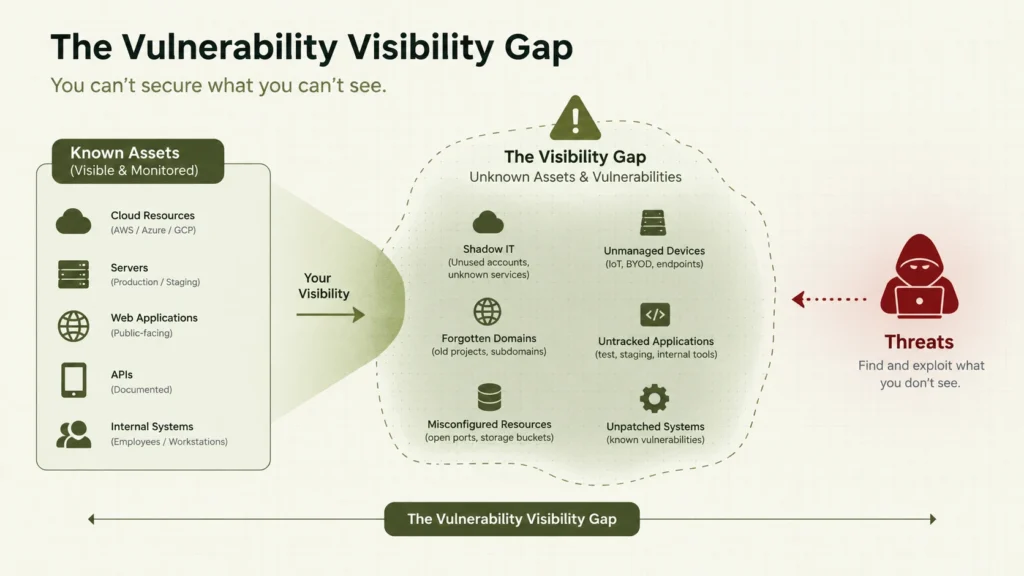
Many organizations have only the second item, and even that is partial. A scanner can tell you what’s wrong with a system it knows about. It can’t tell you about the system it has never seen.
Strong vulnerability visibility joins asset visibility, vulnerability management and attack surface management into one picture. It also draws on vulnerability and configuration management, so you see not only missing patches but also risky settings. If any piece is missing, risk hides in the gap.
Think of it like a building’s security plan. A guard who watches only the front door has “monitoring,” but not visibility. Real visibility means knowing every door, window, vent and back stairwell, and which ones are unlocked.
Why Vulnerability Visibility Matters More in 2026
The problem is getting bigger and faster at the same time.
- Volume: one 2026 analysis counted 131 new CVEs disclosed per day, with 38% rated High or Critical.
- Growth: the attack surface has expanded by more than 67% since 2022, according to TechTarget as cited by INE.
- Speed: threat actors now weaponize newly published vulnerabilities within hours, which makes weekly or monthly scanning obsolete.
- Old flaws: Indusface reports that 56% of older vulnerabilities are still being actively exploited.
When volume is this high and the clock is this short, guessing doesn’t work. Teams with clear vulnerability visibility decide faster and waste less effort. Organizations running preemptive exposure management programs are three times less likely to suffer breaches.
Leadership is paying attention too. In June 2026, the Five Eyes alliance told boards and executives that reducing the attack surface is the first practical step. That moves vulnerability visibility from an IT task to a business priority, and it explains why a regular security risk assessment now appears on many board agendas.
The Four Blind Spots That Destroy Vulnerability Visibility
Every environment has gaps. These four appear most often.
1. Unmanaged and Unknown Assets
Laptops, IoT devices, test servers and old virtual machines get plugged in and forgotten. An asset that isn’t in your inventory isn’t scanned, patched or monitored. Scanners often return findings for assets with no inventory record, and network discovery turns up devices that no team owns.
2. Shadow IT and Shadow AI
Teams sign up for SaaS tools and AI services without telling security. Every unapproved service holds data you can’t protect and a login you can’t monitor. These shadow IT risks quietly erode vulnerability visibility, which is why a clear usage policy matters.
3. Cloud, API and Container Sprawl
Cloud resources appear and disappear in minutes. APIs multiply with every release. A quarterly scan misses everything created in between, so a regular cloud security assessment is essential.
4. Forgotten Internet-Facing Assets
Old marketing sites, abandoned subdomains and legacy login pages sit outside normal processes. They are the easiest entry points for attackers because nobody is watching them. Continuous external attack surface management helps you find them first.
Why Scanners Alone Fail to Deliver Vulnerability Visibility
Vulnerability scanners are essential, but they have limits.
- They only scan what they know about. No inventory entry means no scan.
- They find known flaws. Logic errors, broken access control and chained weaknesses often slip past automated tools.
- They don’t show exploitability. A “High” CVSS score doesn’t tell you whether the flaw is reachable.
- They create noise. Thousands of findings without context lead to alert fatigue.
Even specialized tools have blind spots. A CMS vulnerability scanner won’t understand your custom checkout logic, and database scanning tools won’t see an exposed admin panel. Each tool covers one slice of the picture.
CVEs also tell only part of the story. Arctic Wolf’s 2026 analysis of more than 800,000 IT assets found widespread foundational control gaps that legacy vulnerability management tooling cannot see and that patch or configuration management does not cover. A scanner dashboard can look healthy while real exposure sits outside its view. These are some of the most common vulnerability management challenges teams face today.
Beyond Vulnerability Visibility: The Exposure Gap
This is the part most articles skip. Visibility is necessary, but it isn’t enough.
Check Point’s 2026 Exposure Management Gap report found that critical exposures more than doubled over the past year, yet fewer than one in twelve proved urgent enough to need immediate action. The gap is the distance between seeing a problem, prioritizing it and fixing it safely.
The Hacker News makes a similar point: the industry has spent a decade improving visibility, and that has not automatically produced confident prioritization. More data without context only creates a bigger backlog.
This is why many teams are adopting continuous threat exposure management (CTEM) and a threat-centric vulnerability management approach. Both start from the attacker’s point of view and ask which weaknesses are really exploitable, not just which ones exist.
So the goal isn’t a longer list of vulnerabilities. It is a shorter list of the ones that matter, each with an owner and a deadline.
7 Steps to Improve Vulnerability Visibility
Step 1: Build a Complete Asset Inventory
Start with discovery, not scanning. Combine cloud APIs, network discovery, endpoint agents, DNS records and certificate logs. Your asset inventory is the base layer of vulnerability visibility, and strong asset visibility makes every later step easier.
Step 2: Assign an Owner to Every Asset
An asset without an owner is a vulnerability without a fix. Record a business owner and a technical owner for each system, and treat “no owner” as a finding in itself.
Step 3: Map Your External Attack Surface
Look at your organization the way an attacker does: domains, subdomains, open ports, exposed services, leaked credentials and cloud storage. External penetration testing then validates what this mapping finds.
Step 4: Scan Continuously, Not Occasionally
Move from periodic scans to continuous or event-driven scanning. Automate your vulnerability management workflow so new assets are scanned as soon as they appear, and track results in a single vulnerability management dashboard. Small teams can start simple, since vulnerability management for small business works best with a short asset list, a free scanner and a monthly review.
Step 5: Prioritize by Real Risk, Not Just Severity
Vulnerability prioritization is where visibility turns into action. Combine several signals instead of relying on CVSS alone:
- The CISA Known Exploited Vulnerabilities catalog shows what attackers are using now.
- EPSS estimates the probability that a flaw will be exploited.
- Asset context covers internet exposure, data sensitivity and business impact.
If you’re wondering how to prioritize vulnerabilities, remember the difference between CVE, CVSS and EPSS. A CVE names the flaw, CVSS rates its technical severity, and EPSS estimates how likely it is to be exploited. Use the National Vulnerability Database to look up CVE details and severity scores.
Step 6: Validate With Penetration Testing
Scanners suggest. Testers prove. Penetration testing confirms which weaknesses can actually be exploited and which can be chained into a real attack path. The next section covers this in detail.
Step 7: Fix, Retest and Report
Vulnerability visibility is complete only when the loop closes. Track penetration testing remediation, retest fixed items, and report progress to leadership with a clear vulnerability management report. Application security testing remediation should be tracked the same way, with a named owner and a due date for every finding.
How Penetration Testing Strengthens Vulnerability Visibility
Penetration testing shows the difference between a theoretical weakness and a working attack. It also reveals problems no scanner can: broken business logic, weak access controls and risky combinations of small issues. If you’re new to the topic, think of penetration testing 101 as ethical hacking with permission and a written plan.
Why Penetration Testing Is Important
The importance of penetration testing comes down to proof. It validates real risk, supports audits, and gives leadership clear evidence for budget decisions. It also corrects common penetration testing misconceptions, such as the belief that a clean scan means you’re secure. Done well, ethical hacking penetration testing adds the attacker’s view that your tools can’t provide.
Types of Penetration Testing That Improve Vulnerability Visibility
| Test type | What it reveals |
|---|---|
| Web application penetration testing | Flaws such as injection and broken access control, aligned to the OWASP Top 10. Includes security testing in web applications and application-based penetration tests. |
| External penetration testing and external infrastructure penetration testing | What an internet-based attacker can reach and exploit |
| Internal infrastructure penetration testing | What an attacker can do after gaining a foothold inside |
| Network security assessment and infrastructure penetration testing | Weak segmentation, exposed services and misconfigurations, found through pentesting your network |
| Cloud security assessment | Misconfigured storage, identity and access, and exposed workloads |
| Remote penetration testing | Testing delivered securely over the internet for distributed teams |
| Automated penetration testing and continuous pentest | Frequent checks between full manual tests |
| DevSecOps penetration testing | Security validation built into release pipelines |
| Compliance penetration testing | Evidence for standards such as PCI DSS and ISO 27001 |
You’ll often see “internal vs external pen testing” compared. In short, external tests simulate an outsider, while internal tests simulate a compromised user or insider. Most mature programs need both. Regulated sectors such as banking also require specialized bank penetration testing that covers online banking, APIs and payment systems.
For methodology, see the NIST SP 800-115 technical guide to security testing and the MITRE ATT&CK framework, which maps real attacker techniques. Web testers also follow a documented web application penetration testing methodology, typically based on the OWASP testing guide.
The Penetration Testing Life Cycle
A professional penetration testing life cycle follows six stages:
- Scoping and rules of engagement: agree on the penetration testing scope, targets, boundaries and a pentest plan.
- Reconnaissance: gather information on assets and exposures.
- Vulnerability analysis: identify weaknesses.
- Exploitation: safely prove which ones are real.
- Reporting: deliver a clear pentest report with risk ratings, using a customizable pentest reporting template where possible.
- Remediation and retest: fix issues and confirm they are closed.
A good scope matters. A vague scope leads to missed systems, while a clear one improves vulnerability visibility and keeps the test safe. Understanding the penetration testing risks, such as service disruption, is why rules of engagement are written down and agreed in advance.
Vulnerability Assessment vs. Penetration Testing
Many teams confuse the two. A vulnerability assessment finds and lists weaknesses broadly. Penetration testing goes deeper and proves what an attacker can do. Combined, they are known as VAPT (Vulnerability Assessment and Penetration Testing), and they give the most complete vulnerability visibility. Learn more about our VAPT services.
How Often Should Penetration Testing Be Done?
At minimum once a year, and after major changes such as new applications, cloud migrations or infrastructure updates. High-risk and regulated businesses should test more often, and many add a continuous pentest between full engagements.
How Long Does a Penetration Test Take?
A typical engagement takes from several days to a few weeks, depending on scope, size and complexity. A single web application is faster than a full infrastructure penetration testing project. Penetration testing quotes usually depend on the number of assets, the depth of testing and whether you need retesting included.
Why Choose a Third-Party Penetration Test?
A third-party penetration test gives you independent assurance. Internal teams may miss issues they helped create, while outside testers bring fresh eyes and a recognized report that auditors trust. Many testers also hold credentials such as the Certified Ethical Hacker (CEH) certification, so ask what qualifications your provider’s team has.
Vulnerability Visibility and Compliance
Regulators increasingly expect proof that you know your assets and weaknesses. Good vulnerability visibility makes audits far easier.
- ISO 27001: ISO 27001 expects documented vulnerability management and regular technical reviews.
- PCI DSS: the PCI Security Standards Council requires regular scanning and penetration testing for payment environments.
- FedRAMP: cloud providers working with U.S. agencies need approved processes, including FedRAMP vulnerability scanning tools.
- Regional rules: UAE and Middle East frameworks also expect risk assessments and security testing.
Compliance pentesting delivers evidence of effort, but remember that compliance is the floor, not the ceiling. The best results come when testing is driven by real risk, not only by audit deadlines.
Common Mistakes That Weaken Vulnerability Visibility
Even good teams stumble. Watch for these:
- Treating a scan as a security test. Scans find known issues, while pentests prove exploitability.
- Ignoring unknown assets. What you can’t see, you can’t protect.
- Testing too rarely. An annual test misses everything that changes in between.
- No ownership. Findings without owners never get fixed.
- Fixing by CVSS alone. Severity without context wastes time.
- Skipping the retest. An untested fix is only an assumption.
Metrics That Prove Vulnerability Visibility Is Working
If you can’t measure it, you can’t improve it. Track these:
- Asset coverage: the percentage of known assets under scanning.
- Unknown asset rate: how many assets discovery finds that weren’t in the inventory.
- Mean time to remediate (MTTR): how quickly critical findings are fixed.
- Exposure window: the time between a vulnerability’s disclosure and its fix.
- Ownership coverage: the percentage of assets with a named owner.
- Retest pass rate: how many fixes hold up under retesting.
Over time, these metrics show real attack surface reduction rather than just activity. They also give you strong material for every security risk assessment and board report.
Frequently Asked Questions About Vulnerability Visibility
What is vulnerability visibility in cyber security?
Vulnerability visibility is the ability to see all your assets, the weaknesses on them, and which of those weaknesses attackers can actually exploit. It combines asset discovery, vulnerability scanning and risk prioritization.
Why is vulnerability visibility important?
Attackers exploit new flaws within hours, and attack surfaces keep growing. Without clear visibility, unknown assets stay unpatched, and teams waste time on low-risk findings while critical ones wait.
How do I improve vulnerability visibility?
Build a complete asset inventory, assign owners, map your external attack surface, scan continuously, prioritize by real risk, validate with penetration testing, and retest after fixes.
What is the difference between vulnerability management and attack surface management?
Vulnerability management finds and fixes weaknesses on assets you already know about. Attack surface management continuously discovers all exposed assets, including unknown ones. You need both for complete visibility.
What is the difference between vulnerability assessment and penetration testing?
An assessment lists weaknesses broadly, often with automated tools. Penetration testing proves which weaknesses can be exploited and how far an attacker could go.
Why is penetration testing important?
It validates real risk, uncovers logic flaws that scanners miss, supports compliance, and gives leadership evidence to prioritize fixes.
How often should penetration testing be done?
At least once a year and after major changes. Regulated or high-risk organizations should test more often and consider continuous pentesting.
How long does a penetration test take?
Most take a few days to a few weeks, depending on the penetration testing scope and the number of systems involved.
What is the difference between internal and external pen testing?
External testing simulates an attacker on the internet. Internal testing simulates someone already inside your network. Most organizations need both.
Is vulnerability visibility enough to stop breaches?
No. Visibility must be paired with prioritization and fast, safe remediation. Research calls this the “exposure gap.”
Can small businesses achieve vulnerability visibility?
Yes. Start with a simple asset list, a free check against the CISA KEV catalog, regular scanning and an annual VAPT engagement. You don’t need an enterprise budget.
Get Full Vulnerability Visibility With Nexus Web Security
You can’t reduce risk you can’t see, and you can’t see everything with a scanner alone. Nexus Web Security combines asset discovery, vulnerability assessment and expert-led penetration testing to show you what attackers see and what to fix first. From web application penetration testing to full infrastructure and cloud assessments, our team delivers a prioritized, plain-language report your team can act on.
Ready to find your hidden exposures?
👉 Book a VAPT consultation with Nexus Web Security and get complete vulnerability visibility.