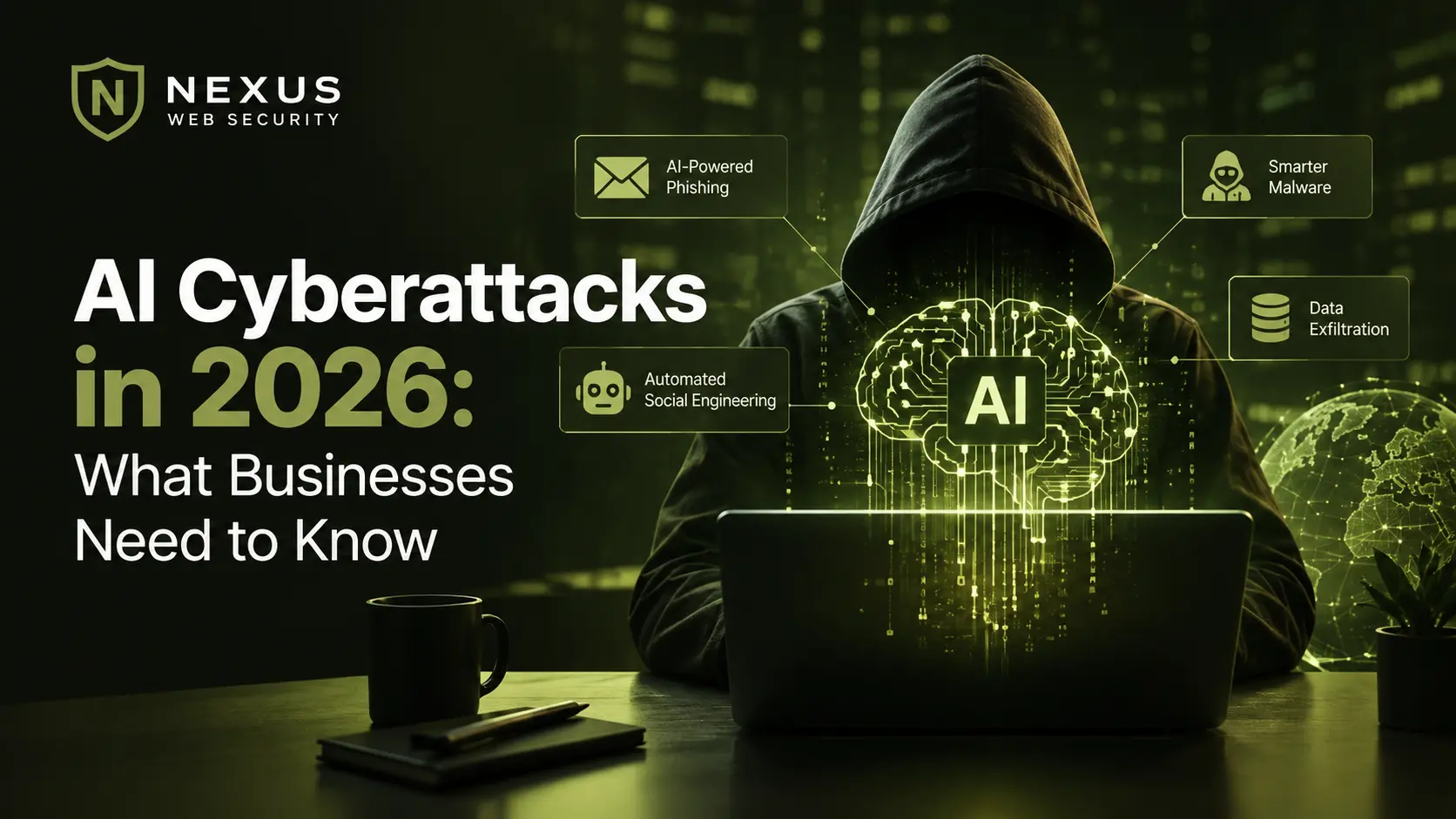
AI cyberattacks in 2026 are now a board-level business risk, not just an IT problem. Attackers use AI to write perfect phishing emails, clone executive voices and exploit software flaws within about 48 hours of disclosure, according to coverage of CrowdStrike’s 2026 threat hunting report.
This guide explains what AI cyberattacks in 2026 mean for your finances, people and customers, which risks matter most, and the exact steps to take in the next 90 days. It is written for owners, managers and security leads, with no jargon. For the full technical breakdown, read our AI cyberattacks 2026 pillar guide.
Quick answer: AI cyberattacks in 2026 make fraud faster, cheaper and more convincing. Businesses should verify payments by a second channel, patch critical flaws within 48 hours, control which AI tools staff use, and test their defences with professional penetration testing.
Table of Contents
AI Cyberattacks in 2026: The Business Picture at a Glance
Four numbers explain why leaders are paying attention to AI cyberattacks in 2026:
- 89%: the year-over-year rise in AI-enabled malicious activity reported by CrowdStrike.
- $6.04 million: the average cost of an AI-enabled breach in IBM’s 2026 research, about $1 million more than breaches without AI, as reported by industry coverage.
- 1 in 4: the share of malicious breaches that were AI-enabled in the same reporting.
- 6 to 12 months: the window in which many AI experts expect a major incident, according to Axios-sourced reporting. This is a forecast, not a fact.
Statistics vary by source and year, so always check what each report measured before you quote it in a board paper.
Why AI Cyberattacks in 2026 Are Different From Older Threats
Old attacks were limited by human effort. AI removes that limit in four ways.
Speed. Experts warn that agentic AI attacks will automate more stages of an intrusion, so fewer hours pass between first access and damage.
Scale. One attacker can now run thousands of tailored campaigns at once, which is why AI cyberattacks in 2026 reach businesses of every size.
Realism. Fake emails, voices and video no longer contain the obvious mistakes staff were trained to spot.
New attack surface. CrowdStrike describes AI as a tool, a target and a force multiplier for attackers. Your own AI tools, agents and integrations are now part of what must be defended.
7 Critical Risks From AI Cyberattacks in 2026
1. Deepfake Payment Fraud
IBM data reported by Nairametrics put deepfake impersonation at 45% of AI-driven attacks. A cloned voice from your “CEO” asks finance for an urgent transfer. One insurer has even launched dedicated deepfake response cover. The defence is procedural: no payment or bank-detail change is approved on a single call, email or video message, however senior the requester sounds.
2. AI-Written Phishing and Business Email Compromise
Cyble reported a 14x surge in AI-generated phishing in December 2025. Messages now reference real suppliers, invoices and projects. Read CISA’s guidance on phishing and brief your teams.
3. Fake Candidates and Deepfake Employees
Analysts list deepfake employees among the key risks of AI cyberattacks in 2026. Fraudulent hires can gain access to systems from day one.
4. Rapid Exploitation of Unpatched Systems
When most newly found vulnerabilities are weaponised within 48 hours, a monthly patch cycle is too slow. Treat internet-facing systems, such as websites, VPNs and APIs, as the first priority, and track time to patch as a leadership metric.
5. Attacks on Your Own AI Tools
Prompt injection can make an AI assistant leak data or take unwanted actions. The OWASP Top 10 for LLM applicationslists the main risks. Even vendors are exposed: GitLab reportedly patched a critical flaw in its AI Gateway this month.
6. Data-Theft Extortion and Ransomware
AI helps criminals sort stolen data, write personalised extortion messages and pick the most valuable victims.
7. Identity and Supply Chain Abuse
Eastgate’s 2026 threat summary highlights OAuth tokens and AI-agent credentials as a growing source of breaches. A compromised vendor or unmanaged AI connection can bypass your perimeter.
What AI Cyberattacks in 2026 Cost Businesses
Direct losses are only part of the bill. Consider:
- Breach costs: the IBM figure above averages $6.04 million for AI-enabled incidents, and you can read the baseline in the IBM Cost of a Data Breach report.
- Downtime and lost sales: UK reporting says ransomware costs now top $1 million.
- Legal exposure: recent research notes new liability questions around AI-driven intrusions.
- Insurance: insurers increasingly ask how you verify payments, manage AI tools and test your systems.
Security leaders are also being asked to prove return on investment. Track outcomes, not activity: time to patch, phishing report rate and retest results.
Which Teams Face the Most Risk From AI Cyberattacks in 2026?
| Team | Main risk | Quick control |
|---|---|---|
| Finance | Deepfake payment requests, invoice fraud | Call-back verification, dual approval |
| HR | Fake candidates, deepfake interviews | Live identity checks, reference verification |
| IT and security | Fast exploitation, shadow AI tools | 48-hour critical patching, approved tool list |
| Customer support | Voice cloning, account takeover | Step-up verification |
| Executives | Impersonation, spear phishing | Code words, limited public voice samples |
| Developers | AI supply chain, leaked tokens | Secrets scanning, testing of AI features |
5 Myths About AI Cyberattacks in 2026 That Put Businesses at Risk
Myth 1: Only large companies are targeted. Automation makes small targets cheap to attack, so attackers no longer need to choose between volume and effort.
Myth 2: Our spam filter will catch it. AI-written messages have no typos and often use real names, so filters alone miss them. Pair email security with process checks.
Myth 3: MFA makes us safe. MFA helps, but attackers trick people into approving access or steal session tokens. Phishing-resistant methods are stronger.
Myth 4: AI is only a threat, never a defence. Defenders also use AI for detection and response. Experts describe AI cyberattacks in 2026 as an arms race, not a one-way street.
Myth 5: A yearly test is enough. Attackers exploit new flaws within about 48 hours, so testing must follow your release cycle, not the calendar.
The 30-60-90 Day Action Plan
Days 1 to 30: close the easy gaps
- Turn on MFA everywhere, preferring phishing-resistant methods.
- Adopt a call-back rule for payment and bank-detail changes.
- Inventory websites, apps, APIs and every AI tool in use.
- Set a 48-hour target for critical patches.
Days 31 to 60: test your people and process
- Run phishing drills using AI-style lures.
- Complete a vulnerability assessment of internet-facing systems.
- Rehearse a deepfake fraud scenario in a tabletop exercise.
- Review vendor and supplier access.
Days 61 to 90: prove it works
- Commission penetration testing of your highest-risk applications and APIs.
- Track remediation to closure, then retest.
- Report five simple metrics to leadership.
- Review cyber insurance terms.
Penetration Testing Against AI Cyberattacks in 2026
A scanner finds known problems. A tester behaves like an attacker and chains weaknesses together, which is how AI-assisted criminals operate. That is why penetration testing is important, and why VAPT combines assessment and testing in one engagement.
Web application penetration testing checks logins, access control, injection flaws and business logic, following the OWASP Top 10. Our web application penetration testing also covers AI chatbots and APIs.
External penetration testing attacks what the internet can see, while internal infrastructure penetration testing assumes an intruder is already inside. In the internal vs external pen testing debate, most businesses need both. An external penetration test is usually the best first step.
Continuous penetration testing matters when attackers move in 48 hours. A continuous pentest repeats checks after releases. Automated penetration testing adds coverage, but people find logic flaws.
Scope and cost. A clear penetration testing scope and rules of engagement keep tests safe. How often should penetration testing be done? At least yearly and after major changes. How long does a penetration test take? Usually days to weeks. Penetration testing quotes depend on scope, depth and compliance needs, and vulnerability assessment pricing is generally lower.
Compliance. Compliance penetration testing supports ISO 27001 vulnerability management, and banks or regulated firms often need a third party penetration test. DevSecOps penetration testing builds checks into your release pipeline, and remote penetration testing suits distributed teams. Network and cloud security assessments complete the picture. Penetration testing remediation, a vulnerability management dashboard and automated vulnerability management keep fixes on schedule.
Questions to Ask Your Security Provider
- How do you test for AI-specific risks such as prompt injection?
- Will the penetration test include APIs and cloud assets?
- How quickly will you report critical findings?
- Do you offer retesting after fixes?
- How is the report written for executives, not only engineers?
- Can you map findings to ISO 27001 or other frameworks?
How to Brief Your Board on AI Cyberattacks in 2026
Boards want clarity, not technical detail. A five-slide brief works well:
- Exposure: which systems, data and payment flows attackers could reach.
- Cost: realistic loss scenarios based on the IBM figures above.
- Controls: what is already in place and what is missing.
- Evidence: penetration testing results and how many findings are fixed.
- The ask: budget, owners and deadlines for the 90-day plan.
Repeat the same metrics each quarter so progress is visible.
AI Governance Basics for AI Cyberattacks in 2026
Write a one-page AI policy: which tools are approved, what data may be entered, who can connect agents to company systems, and how access is revoked. The NIST AI Risk Management Framework is a practical starting structure, and the NIST Cybersecurity Framework covers the wider programme.
FAQ: AI Cyberattacks in 2026
What do businesses need to know about AI cyberattacks in 2026?
Attacks are faster and more convincing, so verify payments, patch quickly, control AI tools and test your defences.
Are small businesses targeted by AI cyberattacks in 2026?
Yes. Automation makes small targets cheap to attack, and they often have fewer controls.
How much do AI cyberattacks in 2026 cost?
AI-enabled breaches averaged $6.04 million in IBM’s 2026 research, as reported, though costs vary widely.
How can I tell if a call or video is a deepfake?
Hang up and call back on a known number, use a code word and treat urgency as a warning sign.
Does cyber insurance cover AI-driven fraud?
Policies differ. Ask your insurer in writing about deepfake fraud, social engineering and verification requirements.
What should we do first about AI cyberattacks in 2026?
Start with payment verification, MFA and a 48-hour patch target. These three controls block the most common fraud and exploitation paths at low cost.
How often should penetration testing be done?
At least once a year, and after major releases, migrations or breaches. Fast-moving teams benefit from continuous testing.
What is the difference between VAPT and a vulnerability scan?
A scan lists known weaknesses automatically. VAPT adds manual testing that proves which weaknesses an attacker can actually exploit.
Is penetration testing worth it?
Yes. It shows how a real attacker would reach your systems and gives a prioritised fix list. You can report phishing and impersonation scams to the FBI IC3.
Conclusion: Prepare for AI Cyberattacks in 2026 Now
AI cyberattacks in 2026 reward fast attackers, but prepared businesses can still win. Verify payments, patch quickly, govern AI tools and test regularly.
Want to know where an AI-assisted attacker would get in? Nexus Web Security’s VAPT services test your website, apps and APIs the way real attackers do and deliver a clear remediation plan. Request your VAPT assessment today.