A hacker calling themselves ChimeraZ says they are selling a French vehicle inspection database taken from SGS. This SGS data breach claim is not confirmed. SGS has not acknowledged an intrusion, and the numbers in the sales listing have not been verified.
Still, the claim matters. The data allegedly includes names, addresses, phone numbers, emails, licence plates and VINs, which is exactly what scammers need. This guide explains what is alleged, what is verified, how to read the numbers and the seven steps to take now. It also covers where penetration testing fits.
Table of Contents
SGS Data Breach Claim: What Has Been Reported
SGS is a Swiss inspection group. In France it runs the vehicle inspection networks Auto Sécurité, Sécuritest and Vérif’Autos. Fuites Infos reports that on 8 November 2026 a database presented as the French part of the group went on sale on a cybercriminal forum, with a sample released freely.
The Claimed Numbers in the SGS Data Breach Claim
According to the listing, the dataset holds about 259 million rows and 96 GB. It reportedly covers nearly 4,000 centres, 90.8 million vehicles, 74.7 million inspections and about 22.7 million people. ZATAZ puts the figure at 22,688,152 people.
These figures are the seller’s claims. Safecode notes that SGS has not confirmed the intrusion and that the volumes are unverified.
What Data Is Claimed
The listing reportedly includes names, postal addresses, email addresses, phone numbers, licence plates, VINs, vehicle makes and models, mileage and inspection dates, according to FrenchBreaches. No passwords or bank details have been reported in the samples seen so far.
Who Is ChimeraZ? A Run of French Leak Claims
The same actor has been named in several recent claims:
- 24 October: a file of 905,097 rows linking about 847,000 French plates to owners
- 31 October: a claim of about 1.9 million people and 2.9 million vehicles
- 4 November: a leak at Auto-Planning, software used by more than 450 inspection centres and driving schools
- 8 November: the SGS data breach claim
SGS Data Breach Facts: Alleged vs Confirmed
Many pages repeat the seller’s numbers as fact. Use this table and expect it to change.
| Claim | Status |
|---|---|
| A database linked to SGS’s French networks is for sale on a forum | Reported by several outlets |
| About 259 million rows, 96 GB | Claimed by the seller, unverified |
| About 22.7 million people, 90.8 million vehicles, 74.7 million inspections | Claimed, unverified |
| Nearly 4,000 centres | Claimed. SGS advertises about 2,000 centres, so treat this with caution |
| A free sample of about 42,000 records | Reported in social posts, which I could not verify |
| Data fields: names, addresses, emails, phones, plates, VINs, mileage | Claimed, based on samples |
| SGS confirmed the intrusion | No confirmation found |
| Passwords or bank data included | Not reported |
| The same actor is behind earlier French plate-data claims | Reported by several outlets |
Compare this with Auto-Planning, where reports say the company acknowledged the incident and notified the CNIL. Nothing similar has been found for SGS.
Rows Are Not People: How To Read the Numbers
The headline figure is 259 million, but it is a count of rows. ZATAZ stresses that rows in a file are not individuals.
One person can appear on many rows: once per vehicle, once per inspection and once per centre they visited. That is why the same listing also mentions 90.8 million vehicles, 74.7 million inspections and 22.7 million people. Each is a different count.
In the SGS data breach claim, “259 million records” is a headline, not a head count. Ask three questions:
- Is that rows, vehicles or people?
- Does the same person appear several times?
- Has the company or a regulator verified it?
The centre count deserves the same care. SGS advertises roughly 2,000 centres across its networks, while the claim mentions nearly 4,000. Until someone explains the gap, do not quote either number as fact.
Is the SGS Data Breach Real? How To Verify a Breach Claim
Sellers exaggerate, and some recycle old data. Here is how to judge a claim like this one:
- Check for official confirmation. Look for a statement from the company or a data protection authority.
- Look for independent analysis. Researchers who examine samples can tell whether records look authentic or recycled.
- Treat unverified totals cautiously. Quote them as claims, never as findings.
Until SGS or an authority speaks, the safest position is simple: assume the data could be real and take sensible precautions, without treating the numbers as proven.
What Criminals Can Do With a Plate, VIN and Mileage
After an SGS data breach, the key risk is linkage. A licence plate alone is not valuable. A plate linked to a name, address, phone number and email is. That combination makes scams look credible.
Fake Fine Texts and Smishing
The most likely abuse is a text message, called smishing, claiming you owe a traffic fine. The scam text can quote your real plate and name. The FBI has warned about fake text and phone scams, including fake fines and toll notices. If you wonder what smishing is, it means phishing by SMS: a short message with a link that steals logins or card details.
A fake fine text with your real licence plate feels official. Do not click. Check by visiting the official fines website yourself.
Cloned Plates
Criminals can copy a legitimate plate onto a similar car, then collect fines that land on the real owner. French sources call these cloned plates “doublettes”.
What Someone Can Do With Your VIN
A VIN identifies one specific vehicle. With it, a scammer can pose as a dealer or insurer and quote details that sound genuine. Fake recall notices and warranty offers are common. The VIN also helps fraudsters build false vehicle histories for stolen or cloned cars. To check whether your VIN has leaked, search for official notices and treat unexpected contacts with caution.
Fake Recall, Insurance and Garage Calls
Expect calls or emails that mention your make, model, mileage and last inspection date. They may claim a safety recall, an insurance adjustment or an overdue service. Cybermalveillance.gouv.fr advises that you always authenticate the caller by contacting the organisation yourself.
7 Steps To Protect Yourself After the SGS Data Breach Claim
Follow these in order. They apply to any vehicle data leak.
Step 1: Do Not Click, and Verify Contacts Yourself
After the SGS data breach claim, if a text, email or call mentions your car, plate or inspection, stop. Find the real phone number or website yourself and contact the organisation directly.
Step 2: Check for Official Notices
If you used an Auto Sécurité, Sécuritest or Vérif’Autos centre, watch for an official SGS data breach notice from SGS or the centre. Do not trust a notice that arrives as an unexpected link.
Step 3: Change Reused Passwords
Start with your email account, because it can reset everything else. Then change banking, cloud and shopping passwords. Never reuse one password across accounts.
Step 4: Turn On MFA
Enable multi-factor authentication on email, banking and cloud accounts. A passkey or authenticator app is stronger than text-message codes. The CISA guide to multi-factor authentication explains the options.
Step 5: Check If Your Email Has Leaked
Use Have I Been Pwned to see whether your email appears in known breaches. If it does, change that password.
Step 6: Add Protection
Privacy tools and anti-phishing software reduce risk. Use a password manager, turn on spam filtering and consider a service that scans links in messages.
Step 7: Report and Keep Records
Report scam messages to your national authority and your mobile carrier. In France, use Cybermalveillance.gouv.fr. Keep screenshots and dates, and tell your bank at once if you see unusual activity.
Phishing Email Examples Using Your Real Car Details
Generic phishing email examples are often sloppy. After an SGS data breach claim, messages built from vehicle data are not. A sample phishing email might say:
- “Your inspection is overdue.” It names your plate and last test date and asks you to pay a fee through a link.
- “Unpaid fine on your vehicle.” It quotes your plate and address and threatens extra charges.
- “Safety recall for your model.” It mentions your VIN and asks you to book a free repair.
Red flags are urgency, a link that does not match the real site, a request for a card number or login and a sender you cannot verify. Never enter credentials from a link.
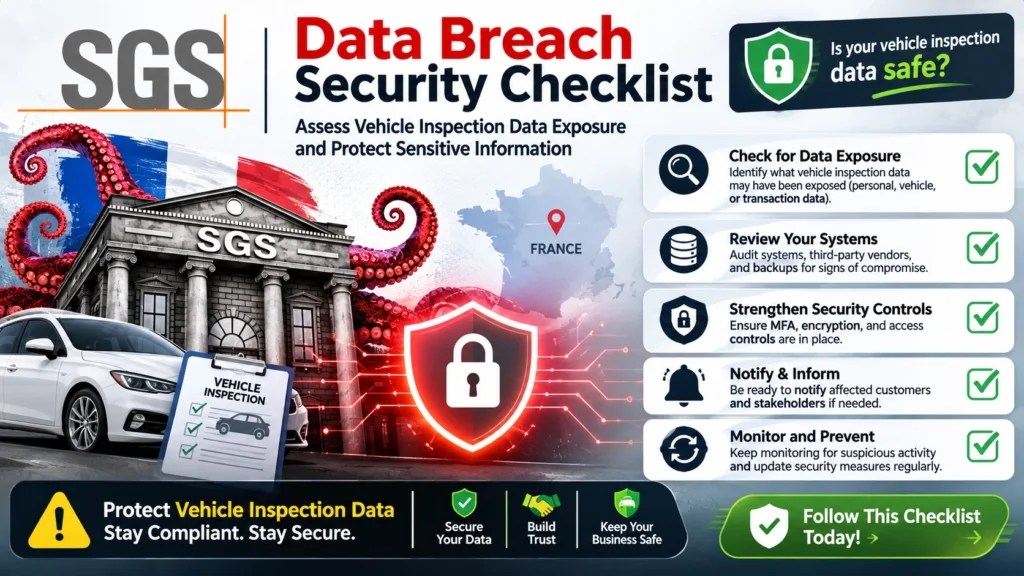
What To Do After a Data Breach: A General Checklist
Use this list for the SGS data breach claim or any other leak:
- Read the official notice and note what data is involved.
- Change the password and any reused copies.
- Turn on MFA everywhere it is offered.
- Check if your email appears in known breaches.
- Watch bank and card statements.
- Treat unexpected messages with suspicion.
- Keep records and follow updates, because early facts change.
Supplier Risk: Lessons From Auto-Planning
The Auto-Planning case, and the SGS data breach claim, show how one supplier or database can expose hundreds of businesses. Appointment and customer management tools hold data for every centre that uses them.
If you run a garage or inspection centre, send your software vendors a short security questionnaire:
- Where is our customers’ data stored, and who can access it?
- Is MFA enforced for staff and for support logins?
- When was the last independent penetration test, and can we see a summary?
- How fast do you notify us after an incident?
- What data do you keep after we stop using the service?
Add the answers to your supplier file. A vendor security questionnaire for inspection centres is quick to send and hard to regret.
Lessons for Garages, Inspection Centres and Small Businesses
The SGS data breach claim is a reminder that customer databases attract attackers, because vehicle and contact data sell well. Use this checklist:
- Know what you store. List every system that holds customer names, addresses, plates and VINs.
- Store less. Data privacy solutions and retention rules reduce what can leak.
- Protect logins. Require MFA and unique passwords for staff and vendors.
- Run a security risk assessment to find where your most sensitive data sits.
GDPR Breach Notification: What Companies Must Do
Under the GDPR, an organisation must normally notify its supervisory authority of a personal data breach within 72 hours of becoming aware of it, unless the breach is unlikely to risk people’s rights. Article 33 of the GDPR sets this out. In France the authority is the CNIL. If the risk to people is high, individuals must be told as well.
This is why official confirmation matters. Once a company confirms a breach, the notification clock and duties follow. This is general information, not legal advice.
Penetration Testing for Customer Databases and Vendor Access
Would a penetration test have prevented the SGS data breach? Nobody outside SGS can say, and no test can promise to stop every attack. What testing does well is find the weaknesses attackers use to reach customer data: exposed systems, weak vendor access, poor access control and forgotten accounts.
That is why penetration testing is important for any business holding customer data. Ethical hacking penetration testing shows how an attacker would move from one weak point to the data behind it.
External Penetration Testing
External penetration testing attacks your public-facing systems the way an anonymous attacker would. It finds exposed portals, weak logins and services that should not be reachable.
Web Application and Infrastructure Penetration Testing
Web application penetration testing checks booking systems, customer portals and APIs against the OWASP Top 10. Infrastructure penetration testing examines the servers and networks behind them.
Automated vs Manual Penetration Testing
Automated penetration testing is quick and affordable. Manual testing finds logic flaws and broken access control that scanners miss. Strong programs use both.
Vulnerability Assessment and Penetration Testing
A scan lists known weaknesses. A test tries to exploit them and shows real impact. Our vulnerability assessment and penetration testing engagements combine both and end with a prioritised report.
Third-Party Penetration Test for Software Vendors
Customers, regulators and insurers increasingly ask software vendors for a third-party penetration test. If you supply tools to many centres, an independent report shows your controls work and shortens security questionnaires.
SGS Data Breach FAQ
Is the SGS data breach claim confirmed?
No. At the time of writing, SGS had not confirmed the intrusion and the volumes had not been verified.
What data is claimed in the SGS data breach?
Names, addresses, phone numbers, emails, licence plates, VINs, vehicle makes and models, mileage and inspection dates.
How many people are affected by the SGS data breach?
The seller claims about 22.7 million people, from about 259 million rows. That figure is unverified, and rows are not people.
What is the biggest risk after the SGS data breach claim?
Convincing scams: fake fine texts, fake recalls and fake insurance or garage calls that use your real plate, name and car details.
How can I tell if a fine text is fake?
Do not click. Visit the official fines website yourself or call the authority using a number you find independently.
Can penetration testing help prevent a breach like this?
It can find exposed systems, weak vendor access and broken access control before attackers do. It works best alongside patching, monitoring and good account hygiene.
Final Thoughts and Next Step
The SGS data breach claim is not confirmed, but the risk is real: a plate, a name and an address are enough for a convincing scam. Verify every contact yourself, protect your accounts and treat unverified numbers as claims, not facts.
Do you hold customer data and want to know how exposed it is? The Nexus Web Security team can test it for you. Request a VAPT assessment today and find out what an attacker would find first.