
Italy fines Meta €805 million over a Facebook feature that suggested photos from Android users’ galleries. On 14 November 2026, Italy’s data protection authority, the Garante, said the Facebook app accessed photos, videos and metadata without specific consent and without properly informing users.
This guide explains what the regulator found when Italy fines Meta, what Meta says, what the decision does not say and what it means for you. It also covers seven steps to protect your photos, lessons for app developers and where penetration testing fits.
Italy Fines Meta €805M: What Happened
The Garante announced the penalty on Saturday 14 November 2026. Its decision targets a Facebook feature called “Get suggestions from gallery when browsing Facebook”. The Next Web reports the feature has been available since 2023 and suggests photos and videos from the phone’s gallery as ideas for posts.
Italy Fines Meta: The Decision in Numbers
| Item | Detail |
|---|---|
| Fine | €805 million (about $887 million) |
| Share of revenue | About 0.47% of Meta’s worldwide revenue |
| Company fined | Meta Platforms Ireland Ltd, which challenged Italy’s jurisdiction |
| Who is affected | Italian Android users of the Facebook app, an estimated 20 million |
| Feature | “Get suggestions from gallery when browsing Facebook”, since 2023 |
| Remedy | 60 days to turn the feature off by default and add a separate, specific consent request |
| Other factor | The amount also reflects a 2019 enforcement action |
| Scale | By far the largest fine the Italian regulator has issued, according to Al Jazeera |
What the Regulator Found When Italy Fines Meta
The Garante’s investigation, which began in mid-2025, found three problems:
- One permission for everything. Facebook asked for gallery access through a single permission covering the whole app and several functions.
- A vague prompt. The request followed a generic notice to “enable other functions”, so users could not tell they were also switching on gallery suggestions.
- On by default. The suggestions feature was enabled by default.
The authority said this broke an Italian law, rooted in the EU ePrivacy Directive, that protects smartphones as part of a person’s private sphere and requires free and informed consent before anyone accesses them.
Italy Fines Meta: Finding vs Appeal vs Unknowns
Many pages mix the regulator’s finding, Meta’s position and guesses. This table keeps them apart. Expect it to change.
| Question | Status |
|---|---|
| Did the Garante fine Meta €805 million? | Yes, announced 14 November 2026 |
| Did it find access without specific consent? | Yes, that is the regulator’s finding |
| Will Meta appeal? | Reportedly yes. One report says Meta strongly disagrees and calls the fine disproportionate |
| Has the fine been paid or upheld on appeal? | No. Appeals take time |
| Did the investigation cover AI training? | No. The Garante did not examine it, and Meta denies using gallery content that way |
| Is the cloud processing feature covered? | No. The Garante will look at it separately |
| Does the decision apply outside Italy? | The ruling is under Italian law. Whether Meta changes the feature elsewhere is unknown |
| Was data stolen or leaked? | No breach was reported. This is a consent case |
What the Decision Does Not Say
When Italy fines Meta, headlines tend to say more than the decision does. Three limits are worth stating plainly.
- It is not about AI training. The probe did not examine whether gallery content trained AI, which Meta denies.
- It is not about all device data. It concerns one Facebook feature on Android and how consent was requested.
- It is not final. Meta plans to appeal, and courts may reduce, uphold or overturn the fine.
That precision matters. Saying “Meta accesses everything on your phone” goes beyond the evidence. Saying “Italy’s regulator found Facebook’s gallery feature lacked specific consent” does not.
What Changes for Users After Italy Fines Meta
Under the decision, Meta must disable the gallery suggestions feature by default, including for users who earlier granted general photo-gallery access, TelecomLead reports. It must also show a separate, specific request that explains what the feature is for, that it involves gallery access and how to switch it off.
That is a 60-day deadline, so changes may not appear immediately. If you use Facebook on Android, do not wait. The steps below let you check your own settings today.
The Separate Cloud Processing Question
Facebook also tests a different feature called “cloud processing”. It asks users to allow ongoing upload of camera roll photos, including ones they never shared, so Meta AI can suggest collages and edits. Security Affairs summarised the original report. Meta says the feature is opt-in and that media is not used to train AI models in the test.
The Garante has said it may examine that feature separately. The €805 million fine does not cover it.
Why Consent Design Matters
The case where Italy fines Meta turns on how permission was asked, not on whether a button existed. The regulator’s message is that a single broad permission does not equal specific consent for each use.
Under the GDPR, consent must be freely given, specific, informed and unambiguous. Article 7 sets the conditions. The ePrivacy Directive adds rules for accessing information stored on a user’s device. In Italy’s reading, both point the same way.
Three design ideas follow:
- Separate each purpose. One permission prompt should not unlock several features.
- Default to off. Privacy by default means optional features start switched off.
- Explain plainly. Say what the feature is for, what data it reads and how to disable it.
Italy Fines Meta in Context: Other Meta Privacy Cases
This is not Meta’s first large penalty, though it is the largest the Italian regulator has issued. The table shows scale and subject.
| Year | Case | Authority | Amount | Core issue |
|---|---|---|---|---|
| 2026 | Facebook Android gallery suggestions | Italy’s Garante | €805M | No specific consent |
| 2019 | Cambridge Analytica | US FTC | $5B | Data shared with third parties |
| 2022 | Cambridge Analytica class action | US court | $725M | Unauthorised data sharing |
| 2024 | Facial recognition “Tag Suggestions” | Texas Attorney General | $1.4B | Biometric data without consent |
| 2021 | Facebook facial recognition | Illinois class action | $650M | Biometric data without consent |
| 2023 | EU–US data transfers | Irish DPC | €1.2B | Inadequate transfer protection |
| 2022 | 2021 data scraping | Irish DPC | €265M | Failure to protect data |
Sources include Infosecurity Magazine and the Enzuzo fines list.
A different case shows why permissions are not the whole story. In 2025 researchers reported that Meta Pixel scripts passed browser identifiers to Facebook and Instagram apps on Android through the localhost interface, a technique they called “Local Mess”. The Register reported that Meta stopped it after the disclosure. Android needed no permission for it, so no prompt was shown.
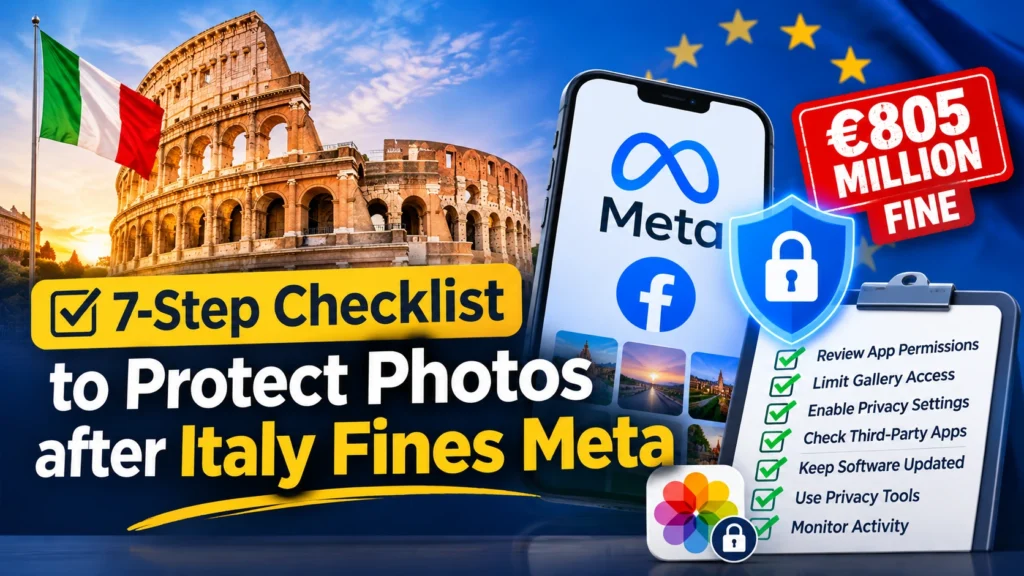
7 Steps To Protect Your Photos After Italy Fines Meta
You do not need to wait for Meta to change its app now that Italy fines Meta. These steps limit what any app can see.
Step 1: Turn Off Facebook Camera Roll Suggestions
In the Facebook app, go to Settings & privacy, then Settings, then Preferences, then Camera roll sharing suggestions. Turn off the toggle for suggestions while browsing and the toggle for cloud processing. Menu names can change, so look for “camera roll”.
Step 2: Limit Photo Permission
On your phone, set Facebook’s photo access to “selected photos” or “none” where your system offers it. You can always grant access to a single photo when you want to post it.
Step 3: Check Which Apps Can See Your Photos
Open your phone’s privacy or permission manager and review every app with photo access. Remove access from apps that do not need it.
Step 4: Revoke Old Permissions
If you granted broad access years ago, revoke it. A permission given for one feature can quietly cover newer ones.
Step 5: Review Cloud Backup and Sync
Check which apps upload photos automatically. Understand what is stored, where and for how long.
Step 6: Reduce Web-to-App Tracking
Use a browser with tracker blocking, avoid in-app browsers and delete apps you do not use. The EFF’s advice covers these steps.
Step 7: Keep Your Phone and Apps Updated
Updates bring tighter permission controls. Review settings again after major updates, because new features can add new prompts.
How To Limit Photo Access on Android and iPhone After Italy Fines Meta
Menu paths vary by phone and software version. These are the usual routes.
Android: open Settings, then Security and privacy or Privacy, then Permission manager. Choose Photos and videos, select Facebook and choose limited access or “don’t allow”.
iPhone: open Settings, then Privacy & Security, then Photos. Select Facebook and choose Selected Photos or None.
Inside Facebook: use the Camera roll sharing suggestions page described in Step 1.
If you cannot find a setting, search your phone’s settings for “photos” or “permissions”.
Lessons for Businesses After Italy Fines Meta
When Italy fines Meta over a consent prompt, every team that builds apps should read the decision. Use this checklist:
- One purpose, one request. Do not bundle several features behind one permission.
- Default to off. Optional features should start disabled.
- Explain in plain language. State what the feature is for, what it reads and how to switch it off.
- Record consent. Keep evidence of who agreed, when and to what.
- Test the whole flow. Check what users see on first launch, after updates and after changing settings.
- Review old permissions. New features should not inherit consent given for old ones.
Treat this as part of data compliance and security compliance. A clear data compliance process lists every data type, purpose, legal basis and retention period. SOC compliance programmes add evidence that privacy controls work. Data privacy solutions can help manage consent records, but they do not replace good design.
Would a Privacy Audit or Penetration Test Catch This?
Not entirely. The case where Italy fines Meta is a consent and design issue, so legal review and a privacy impact assessment are essential. But testing helps with the technical side: what an app actually reads, what it sends and whether permissions work as described.
That is why penetration testing is important for any app that touches personal data. Ethical hacking penetration testing shows what an attacker, or a curious researcher, could see.
Compliance Penetration Testing
Compliance penetration testing maps technical tests to the rules you must meet. It can check that consent settings are honoured, that defaults are correct and that data does not leave the device unexpectedly.
External Penetration Testing
External penetration testing attacks your public-facing systems the way an anonymous attacker would. It finds exposed APIs, weak logins and leaked data.
Mobile and Web Application Penetration Testing
Web application penetration testing and mobile app testing check login flows, permissions and data handling against standards such as the OWASP Mobile Application Security guide.
Automated vs Manual Penetration Testing
Automated penetration testing is quick and suits regular checks. Manual testing finds logic flaws and permission mistakes that scanners miss. Strong programs use both.
Vulnerability Assessment and Penetration Testing
A scan lists known weaknesses. A test tries to exploit them and shows real impact. Our vulnerability assessment and penetration testing engagements combine both and end with a prioritised report.
Third-Party Penetration Test
Regulators, partners and insurers often ask for a third-party penetration test. An independent report shows your data controls work.
Italy Fines Meta FAQ
Did Italy really fine Meta €805 million? What does it mean when Italy fines Meta?
Yes. Italy’s data protection authority announced the fine on 14 November 2026. When Italy fines Meta, it is a regulator’s finding that Meta can appeal.
Why did Italy fine Meta?
The regulator found that Facebook’s Android app accessed photos, videos and metadata through a gallery suggestions feature without specific consent and without adequately informing users.
How many people are affected?
An estimated 20 million Italian Android users, according to reports.
Will Meta appeal?
Reportedly yes. One report says Meta strongly disagrees and calls the fine disproportionate. Confirm with Meta’s own statement and the regulator.
Does the fine mean Meta used my photos to train AI?
No. The investigation did not examine AI training, and Meta denies using gallery content that way.
What must Meta change?
Turn the gallery suggestions feature off by default, and ask for specific consent with a clear explanation, within 60 days.
Does this apply outside Italy?
The decision is under Italian law. Whether Meta changes the feature in other countries is not known.
How do I turn off Facebook’s gallery suggestions?
Go to Settings & privacy, Settings, Preferences, then Camera roll sharing suggestions, and switch off the toggles.
Is the cloud processing feature covered by the fine?
No. The regulator said it may look at that feature separately.
What can app developers learn from the decision?
Ask for each permission separately, default optional features to off and explain plainly what each feature does.
Final Thoughts and Next Step
When Italy fines Meta €805 million over a consent prompt, the lesson is clear: permission is not consent unless people understand what they are allowing. Check your own settings today, and if you build apps, fix your consent flows before a regulator does.
Want to know what your app actually reads and sends? The Nexus Web Security team can test it for you. Request a VAPT assessment today and find out what an attacker would find first.