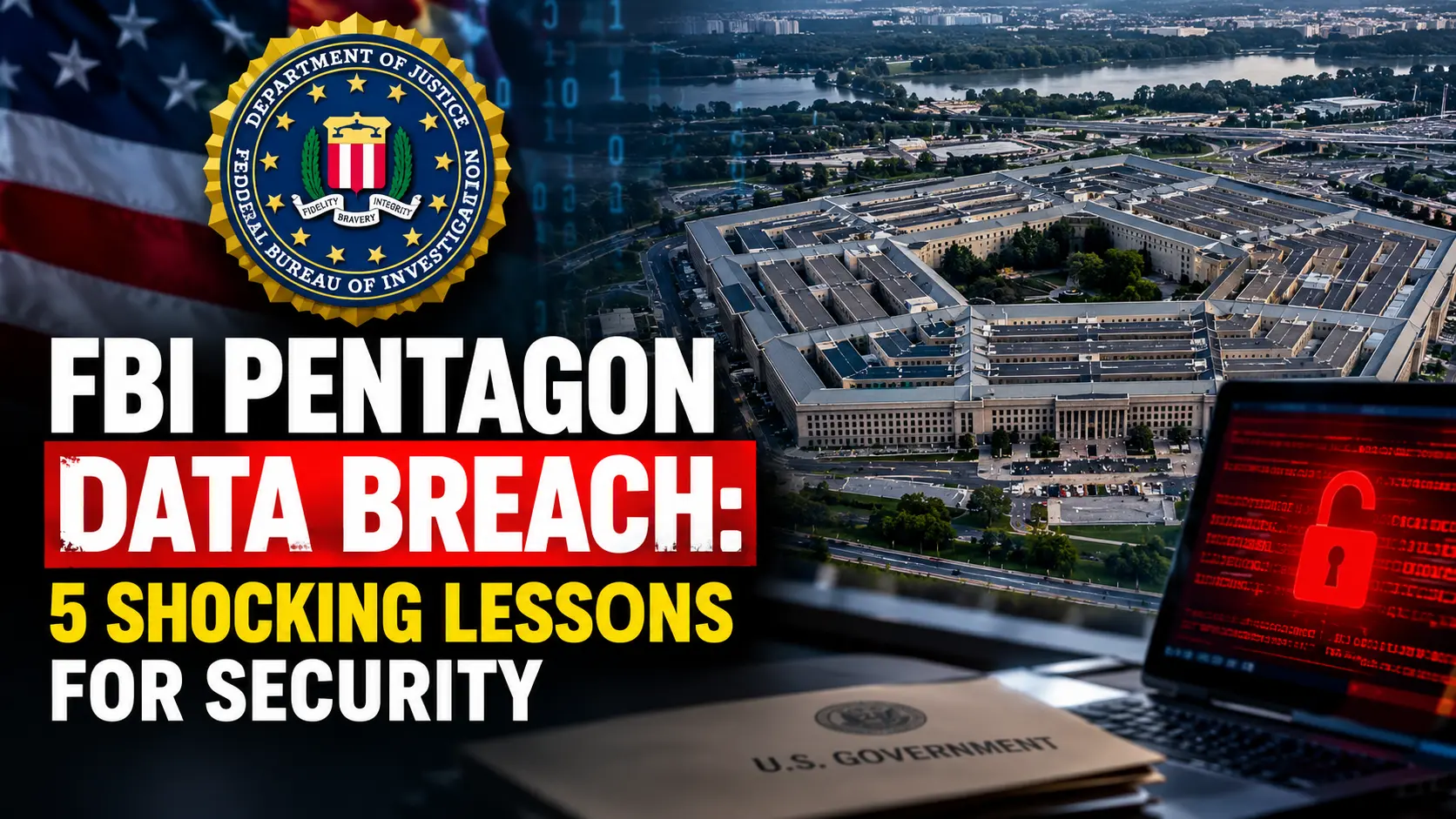
The FBI Pentagon data breach headlines landed within days of each other. The Department of Defense (now styled the Department of War) confirmed that more than 3 million people’s records were exposed. The FBI was investigating a breach of its jobs portal affecting agents and applicants.
Here is the irony. The two agencies that warn private companies about cyber risk were hit by the same problems: unpatched software, weak data protection and third-party exposure.
The damage is large. Pentagon officials say 2.76 million living and 294,000 deceased people were affected. On the FBI side, the group ShinyHunters claims it holds data on thousands of agents and applicants.
This guide separates what is confirmed from what is only claimed. It also shows what your organization should do next.
Table of Contents
Case Study 1: The Pentagon (DMDC) Breach
Silent Vulnerability: 3 Million Records Exposed
The Defense Manpower Data Center (DMDC) keeps personnel records for the Pentagon. It holds at least 60 million records on troops, civilians, contractors, family members and veterans, according to SecurityWeek.
DMDC began sending notification letters dated September 18. The letters say that on July 16, 2026, staff found a security flaw in a file-sharing system. The flaw let unauthorized users reach files.
What Data Was Exposed?
The exact data varied by person. Exposed records included:
- Names and dates of birth
- Social Security numbers
- Contact details and demographic data (sex and race)
- Military occupational specialties and service details
About 294,000 of the affected people are deceased. That complicates identity-theft prevention, because nobody is watching those identities. Criminals can use them for fraud, and families may not notice for years.
The Technical Failure: Nine Months Undetected
A Pentagon official told Federal News Network that a “small number of unauthorized users” had access from October 2025 to July 2026. That is roughly 9 months of silent exposure.
The files were also unencrypted. The official declined to say who accessed the data. The official also declined to explain why such sensitive data sat on an unencrypted server.
Defense officials say they see no evidence of misuse so far. DMDC patched the flaw and is offering 12 months of credit monitoring through IDX, as Bitdefender’s coverage notes.
This is the kind of gap that regular vulnerability assessment and penetration testing is built to find, before an attacker does.
Case Study 2: The FBI and ShinyHunters
Retaliation and Zero-Days: The Attack on FBIjobs.gov
On September 22, 2026, ShinyHunters said it had breached the FBI. The group posted a statement claiming it holds “very sensitive data on almost ALL FBI Agents and individuals who filed an application.” The Hacker News reported the claim.
The FBI’s public statement was more careful. It said it was aware of a cyber-criminal group claiming a compromise of the FBIJobs.gov portal and alleged impact to employee personal information. Cybersecurity Dive covered that statement.
The Motive: Why Target the FBI?
ShinyHunters says this was retaliation, not a payday. The group points to a May 2026 FBI advisory about its tactics, which it calls false. It demanded the bureau “correct or simply REMOVE” the advisory, according to Cybernews.
The deadline passed and the advisory stayed online. The group later told NBC News it would not publish the stolen data, as NBC News reported.
The Technical Vector: Oracle PeopleSoft
ShinyHunters says it used an Oracle PeopleSoft zero-day to gain remote code execution. It says it then moved into FBI-managed infrastructure and took 2 to 3 terabytes of data.
Security researchers add context. Vectra’s analysis says the same PeopleSoft family of flaws was exploited in June against universities. In September the group allegedly slipped past firewall protections with a single-character change in a web request.
The terabyte figures come from the group itself. Reporting from Help Net Security says the FBI’s applicant portals stayed offline for days. The FBI has also said it has not yet determined whether the breach began inside the bureau or through a third-party provider.
The Danger: Personal Data of Agents and Applicants
The group’s published sample reportedly included names, home addresses, phone numbers and emergency contacts. Cybersecurity Dive reports that people familiar with the breach called it a major counterintelligence failure. They warned it could lead to harassment or stalking of agents.
Nobody has publicly confirmed that undercover operatives were exposed. But accurate home addresses of law enforcement staff are a serious safety risk by themselves.
Pentagon vs. FBI: Side-by-Side Comparison
| Factor | Pentagon (DMDC) | FBI (FBIjobs.gov) |
|---|---|---|
| People affected | 2.76M living + 294K deceased (confirmed by officials) | Thousands of agents/applicants (claimed) |
| Data types | Names, SSNs, birth dates, job specialties | Names, addresses, phones, emergency contacts (claimed) |
| Cause | File-sharing system flaw; unencrypted files | Alleged Oracle PeopleSoft zero-day |
| Exposure window | About 9 months (Oct 2025 – Jul 2026) | Claimed September 2026 |
| Attacker | Unknown | ShinyHunters (claimed) |
| Confirmation level | Confirmed by Pentagon | FBI confirms investigation; scale unverified |
The Global Counter-Offensive
The Arrest in Amsterdam
On September 15, Dutch police arrested a 24-year-old Amsterdam man. They allege he is a leader of ShinyHunters. CyberScoop reports the arrest came about a week before the group’s FBI claim. Neither Dutch police nor the FBI has formally tied him to the jobs-portal breach.
ShinyHunters responded that the individual “has no association” with the group.
The FBI’s Message: “We Know How to Find You”
On September 29, FBI Cyber Division Assistant Director Brett Leatherman released a video aimed at the group’s remaining members. He warned that “you know how to find us, and we know how to find you,” as BleepingComputerreported.
Leatherman said ShinyHunters and its associates have allegedly breached more than 140 organizations and collected at least $70 million in extortion payments. He urged members to come forward first. NPR also covered his appeal.
Editorial Analysis: What the FBI Pentagon Data Breach Means
Cyber Conflict Is About Leverage, Not Just Money
ShinyHunters says it wanted a retraction, not a ransom. Whether or not that claim holds up, the lesson is clear. Attackers now target personal data for pressure, retaliation and influence.
Personnel data is a perfect tool for this. It supports phishing, impersonation, harassment and foreign intelligence targeting. A stolen address cannot be reset like a password.
Legacy Systems and Third-Party Tools Widen the Attack Surface
Both incidents share a root cause: exposed systems that held too much sensitive data. One was a file-sharing server with unencrypted files. The other was a recruiting portal built on enterprise software that hackers had already attacked months earlier.
When organizations delay legacy application modernization and patching, attackers get a long window. Third-party vendors widen it further, because you inherit their weaknesses.
5 Lessons for Your Security Team
- Encrypt sensitive data at rest. Unencrypted SSNs on a server turn a single flaw into a catastrophe.
- Patch and verify. The PeopleSoft campaign shows that a “fix” or firewall rule is not always the end of the story. Test that it works.
- Segment internet-facing portals. An applicant portal should never be a doorway to internal systems.
- Monitor for long-dwell intrusions. Nine months of undetected access means logging and alerting failed.
- Test like an attacker. Regular web application penetration testing finds exposed portals and flawed file-sharing before criminals do.
Careers pages and HR portals deserve special attention. They are internet-facing, store dense personal data and often run on older vendor software. Strong security testing in web applications should cover them first.
Final Thought: A Wake-Up Call for National Security
The FBI Pentagon data breach shows that even the best-funded agencies struggle with basics: encryption, patching and vendor risk. Government must make encryption the default, retire legacy exposure and test its public portals continuously.
Private companies face the same choice. Fix the basics now, or explain a breach later.
FAQ: FBI Pentagon Data Breach
What was the FBI Pentagon data breach?
It refers to two separate incidents in September 2026. The Pentagon’s Defense Manpower Data Center confirmed that data on more than 3 million people was exposed. Separately, ShinyHunters claimed it stole FBI agent and applicant data from the FBI jobs portal.
Has the FBI confirmed the ShinyHunters breach?
The FBI confirmed it is investigating a compromise of FBIJobs.gov and possible exposure of employee personal data. It has not confirmed the group’s claimed data volume or that “almost all” agents were affected.
Who is affected by the Pentagon DMDC breach?
About 2.76 million living and 294,000 deceased individuals. DMDC is sending notification letters and offering 12 months of credit monitoring.
What is an Oracle PeopleSoft zero-day?
It is a previously unknown flaw in PeopleSoft, widely used for HR and payroll. Attackers can exploit it before a vendor patch exists. ShinyHunters says it used one against the FBI, but this is unconfirmed.
How can organizations prevent a similar breach?
Encrypt sensitive data, patch quickly, segment public portals, monitor logs and run regular external penetration testing. Review your vendors’ security as well.
Protect Your Organization Before Attackers Test It
If the FBI and the Pentagon can be exposed, your careers page, file-sharing tools and customer portals can be too.
Nexus Web Security offers VAPT services that find exploitable weaknesses before criminals do. You get clear findings, prioritized fixes and expert remediation guidance.