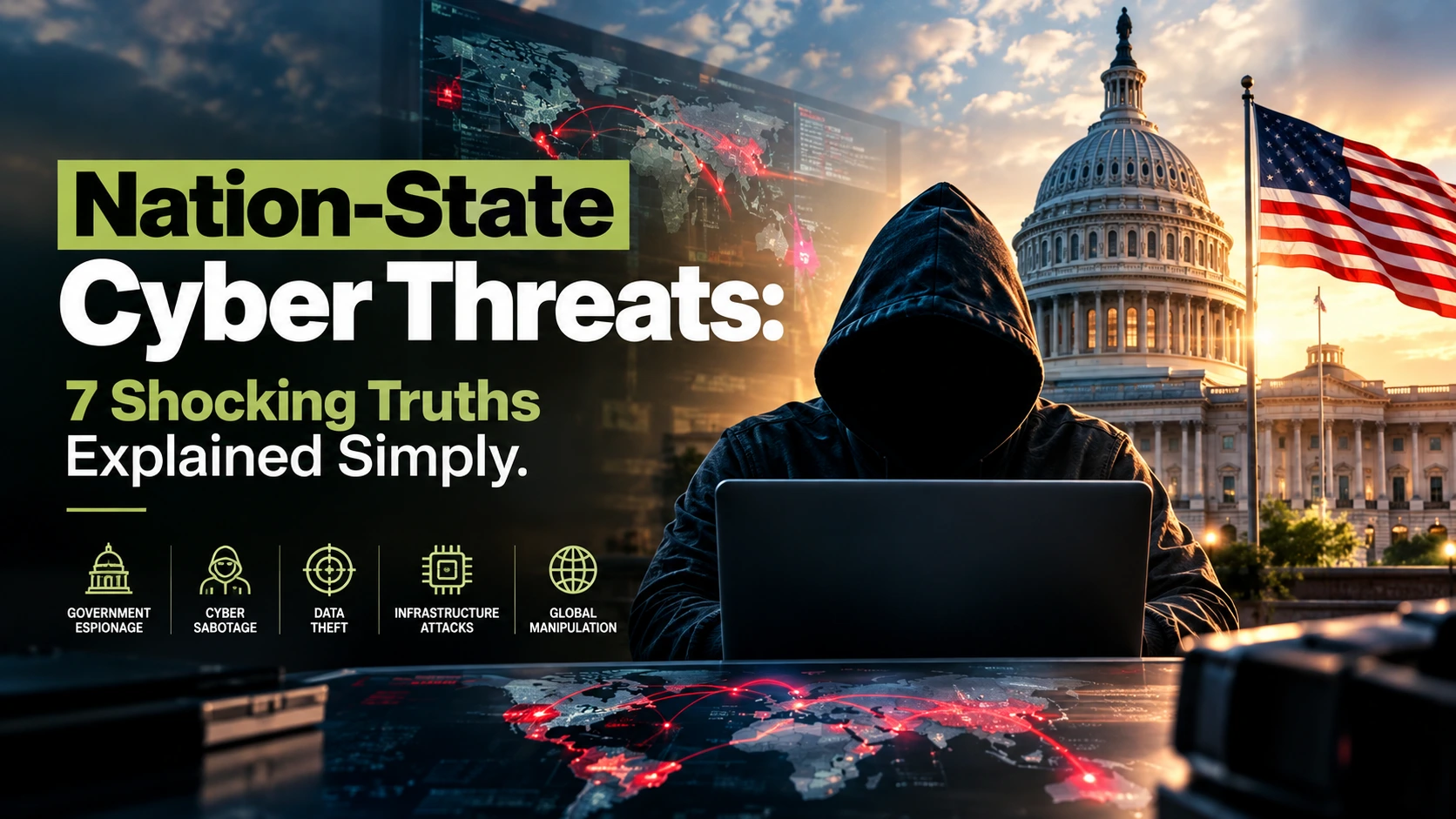
Nation-state cyber threats are hacking campaigns run or backed by a government to spy on, disrupt, or damage another country, company, or organization. They are patient, well funded, and built to stay hidden for months or even years.
Most people assume these attacks only hit presidents, armies, and power grids. That is no longer true. Today, nation-state cyber threats reach suppliers, hospitals, banks, and small businesses that simply sit on the path to a bigger target.
This guide explains how nation-state cyber threats work in plain English. You will learn who is behind them, what they want, how an attack unfolds step by step, and what you can do to stay protected.
Table of Contents
What Are Nation-State Cyber Threats?
A nation-state cyber threat is an attack carried out by, or on behalf of, a government. The attackers may be soldiers, intelligence officers, or contractors working under state direction.
Security teams often call these groups an advanced persistent threat, or APT. If you have ever wondered what APT means, it describes an attacker that is skilled (advanced), keeps coming back (persistent), and poses a serious danger (threat). The U.S. Cybersecurity and Infrastructure Security Agency tracks many of these actors on its nation-state cyber actors page.
Here is the simple version. Think of a burglar who studies your home for months, copies your keys, and moves in quietly. They do not smash a window. They want to stay unnoticed.
That patience is what makes nation-state cyber threats so different from everyday hacking.
Why Governments Launch Nation-State Cyber Threats
Governments do not hack for fun. Every campaign serves a goal.
Espionage
Cyber espionage is the most common motive. Attackers steal secrets, such as government plans, defense designs, research data, and business strategy.
Intellectual Property Theft
Why spend ten years on research when you can steal it? State-backed groups often target technology, pharmaceutical, and manufacturing firms to boost their own industries.
Disruption and Sabotage
Some nation-state cyber threats aim to break things. Attackers may disable power, water, transport, or communication systems during a political crisis or conflict.
Financial Gain
Some governments use hacking to raise money. Stolen cryptocurrency and bank theft can help countries that face heavy sanctions.
Influence and Pressure
Leaks, defaced websites, and disinformation campaigns can shape public opinion or weaken trust in institutions.
How Nation-State Cyber Threats Work: The Attack Lifecycle
Understanding how nation-state cyber threats work starts with the attack lifecycle. Security professionals often describe it with the cyber kill chain or the MITRE ATT&CK framework. Both break an attack into stages.
Step 1: Reconnaissance
Attackers research the target first. They collect employee names, email formats, software versions, and vendor relationships from public sources.
Step 2: Initial Access
Next, they find a way in. This might be a phishing email, a stolen password, or a flaw in an internet-facing device such as a VPN or firewall.
Step 3: Persistence
Once inside, attackers install backdoors so they can return even if the first entry point is closed. This is the “persistent” part of an APT.
Step 4: Privilege Escalation and Lateral Movement
Attackers then look for administrator accounts. They move quietly from one system to another, often using normal tools so their activity blends in with everyday work.
Step 5: Data Theft or Impact
Finally, they act. They may copy sensitive files slowly to avoid alarms, or they may prepare to disrupt systems at a chosen moment.
Step 6: Covering Tracks
Skilled groups delete logs and hide their tools. This is why many victims learn about a breach months after it begins.
Common Techniques Used in Nation-State Cyber Threats
Nation-state cyber threats use many methods. These are the ones you will meet most often.
Spear Phishing
Phishing sends fake emails to many people. Spear phishing targets one person with a message that looks personal and believable.
If you want to know how phishing works, the idea is simple. The email tricks someone into clicking a link, opening a file, or sharing a password. Today, AI is changing phishing strategies by making these messages cleaner and more convincing.
Zero-Day Exploits
A zero-day exploit uses a software flaw that the vendor does not yet know about. No patch exists, so defenders have no time to prepare. Well-funded state groups are among the few actors who can find or buy these flaws at scale.
Software Supply Chain Attacks
Why break into a hundred companies when you can break into the one that supplies them all? In a software supply chain attack, criminals tamper with trusted software or an update so that customers install the threat themselves.
Living Off the Land
In these attacks, intruders use tools already built into your systems, such as remote administration utilities. Because the tools are legitimate, many security products do not flag them.
Edge Device Exploitation
Routers, VPNs, and firewalls sit at the border of a network, and they often lack strong monitoring. State-backed groups regularly target them as a quiet way in.
Nation-State Cyber Threats vs. Cybercriminals
Both groups hack for results, but their goals and methods differ.
| Feature | Nation-State Actors | Cybercriminals |
|---|---|---|
| Main goal | Intelligence, disruption, strategic advantage | Money |
| Funding | Government-backed, large budgets | Self-funded or criminal networks |
| Patience | Months or years | Days or weeks |
| Tools | Custom malware, zero-days | Off-the-shelf kits, ransomware |
| Stealth | Very high | Moderate |
| Typical targets | Governments, infrastructure, suppliers | Anyone who can pay |
The line is not always clean. Some state-linked groups use ransomware as cover, and some criminals reuse tools leaked from government programs. Either way, strong basics protect you from both.
Real-World Examples of Nation-State Cyber Threats
Cyber attack examples help make the risk real. Four cases are worth knowing.
Stuxnet
Stuxnet was a worm discovered in 2010 that damaged centrifuges at an Iranian nuclear facility. It is widely seen as the first cyber weapon to cause physical damage, and it is widely attributed to the United States and Israel.
SolarWinds
In 2020, attackers slipped malicious code into a trusted software update from SolarWinds. Thousands of organizations received it, and U.S. officials attributed the campaign to Russian intelligence. It remains the textbook example of a supply chain attack.
NotPetya
In 2017, NotPetya spread from Ukraine to companies around the world. It looked like ransomware, but it was built to destroy data. Governments attributed it to Russian military actors, and the damage ran into billions of dollars.
Volt Typhoon
Volt Typhoon is a China-linked group that U.S. agencies say pre-positioned itself inside critical infrastructure networks. Pre-positioning means gaining access now so the attacker can disrupt services later.
Who Is at Risk from Nation-State Cyber Threats?
Large targets are obvious. Governments, defense contractors, energy providers, healthcare systems, and financial institutions attract the most attention.
But small and mid-sized businesses are in danger too. Why?
- They often supply or serve larger companies.
- They usually have fewer security staff.
- They may hold credentials that open doors elsewhere.
In other words, you do not need to be the target to become the stepping stone. If your company handles data, software, or services for bigger clients, nation-state cyber threats are part of your risk picture.
How to Detect Nation-State Cyber Threats
Detection is hard, but not impossible. Watch for these warning signs:
- Logins at unusual hours or from unusual countries
- New administrator accounts that nobody created
- Large, unexplained data transfers
- Security tools switched off or logs deleted
- Strange activity on VPNs, firewalls, or routers
- Phishing emails that mention real projects or colleagues
Strong cyber threat detection relies on layers. Endpoint detection and response (EDR) tools watch devices for suspicious behavior. Proactive threat hunting looks for attackers who have already slipped past alarms. Quality threat intelligence tells your team which tactics are active right now.
A security risk assessment also helps by showing which systems attackers are most likely to target first.
How to Defend Against Nation-State Cyber Threats
You cannot stop every attacker, but you can make yourself a much harder target. Use these steps to reduce your exposure to nation-state cyber threats.
1. Master the Basics
Most successful intrusions still begin with weak passwords, missing patches, and unprotected accounts. Turn on multi-factor authentication everywhere, patch quickly, and remove unused accounts.
2. Test Your Defenses Regularly
Do not wait for attackers to find your weak spots. Vulnerability assessment and penetration testing (VAPT) lets ethical hackers probe your systems the way a real adversary would, and then hand you a clear fix list. Many teams ask how often penetration testing should be done. A good rule is at least once a year, and after any major change to your network or applications.
3. Run Red Team Exercises
A red team exercise simulates a determined attacker over weeks. It tests your people, processes, and technology together. Pair it with infrastructure penetration testing so you cover both your network and the human layer.
4. Segment Your Network
Split your network into zones. If an intruder lands in one area, segmentation stops them from walking freely into the rest.
5. Monitor and Hunt
Collect logs, deploy EDR, and review alerts daily. Add managed network security if you lack an in-house team.
6. Secure Your Supply Chain
Ask vendors about their own security. Review software updates before wide rollout and limit the access your suppliers have to your systems.
7. Prepare an Incident Response Plan
When something goes wrong, minutes matter. A written incident response plan tells everyone who to call, what to isolate, and how to recover. Practice it before you need it.
8. Train Your People
Humans remain the favorite way in. Regular awareness training teaches staff to spot spear phishing and report it fast.
For a trusted baseline, follow the NIST Cybersecurity Framework. It organizes good practice into identify, protect, detect, respond, and recover.
Why Attribution Is So Difficult
When a breach happens, people ask one question: who did it?
The honest answer is often “we are not sure.” Attackers route traffic through other countries, borrow each other’s tools, and sometimes plant false clues. Analysts compare code, infrastructure, timing, and tactics, and governments often add intelligence that the public never sees.
Even then, attribution comes with confidence levels, not certainty. That is why careful reporting says “assessed to be linked to” rather than “proven to be.”
For defenders, the lesson is practical. You do not need to know who attacked you to stop the attack. Focus on closing the door, finding the intruder, and recovering fast.
Frequently Asked Questions
What is a nation-state cyber attack?
It is a cyber attack carried out or sponsored by a government. The aim is usually spying, theft of secrets, or disruption rather than quick profit.
Who are the biggest sources of nation-state cyber threats?
Government agencies in several countries have named state-linked actors from Russia, China, North Korea, and Iran. Many other nations run cyber programs as well, though attribution is often debated.
How are nation-state cyber threats different from ransomware?
Ransomware gangs want money quickly. Nation-state cyber threats focus on long-term access, intelligence, or strategic damage. Some state actors do disguise attacks as ransomware.
Can small businesses be targets?
Yes. Small firms are often used as stepping stones to larger partners, so attackers may target them because of who they serve.
How can I tell if a nation-state attacker is inside my network?
Look for odd logins, new admin accounts, hidden data transfers, and disabled security tools. Threat hunting and professional testing find what automated alerts miss.
Can you fully prevent nation-state cyber threats?
No one can guarantee full prevention. You can, however, lower the risk sharply with layered defenses, regular testing, fast patching, and a practiced response plan.
How often should I test my security?
Most organizations should run penetration testing at least once a year and after major system changes. High-risk sectors may need more frequent testing.
Final Thoughts
Nation-state cyber threats are no longer just a government problem. They are a business problem, a supply chain problem, and a people problem.
The good news is that these attackers still depend on common weaknesses. Close those gaps, test your defenses, watch for warning signs, and rehearse your response.
Ready to find your weak spots before an attacker does? Our team at Nexus Web Security can help you uncover and fix real risks with expert penetration testing and vulnerability assessment. Contact us today to book your security assessment and take the first step toward stronger protection.