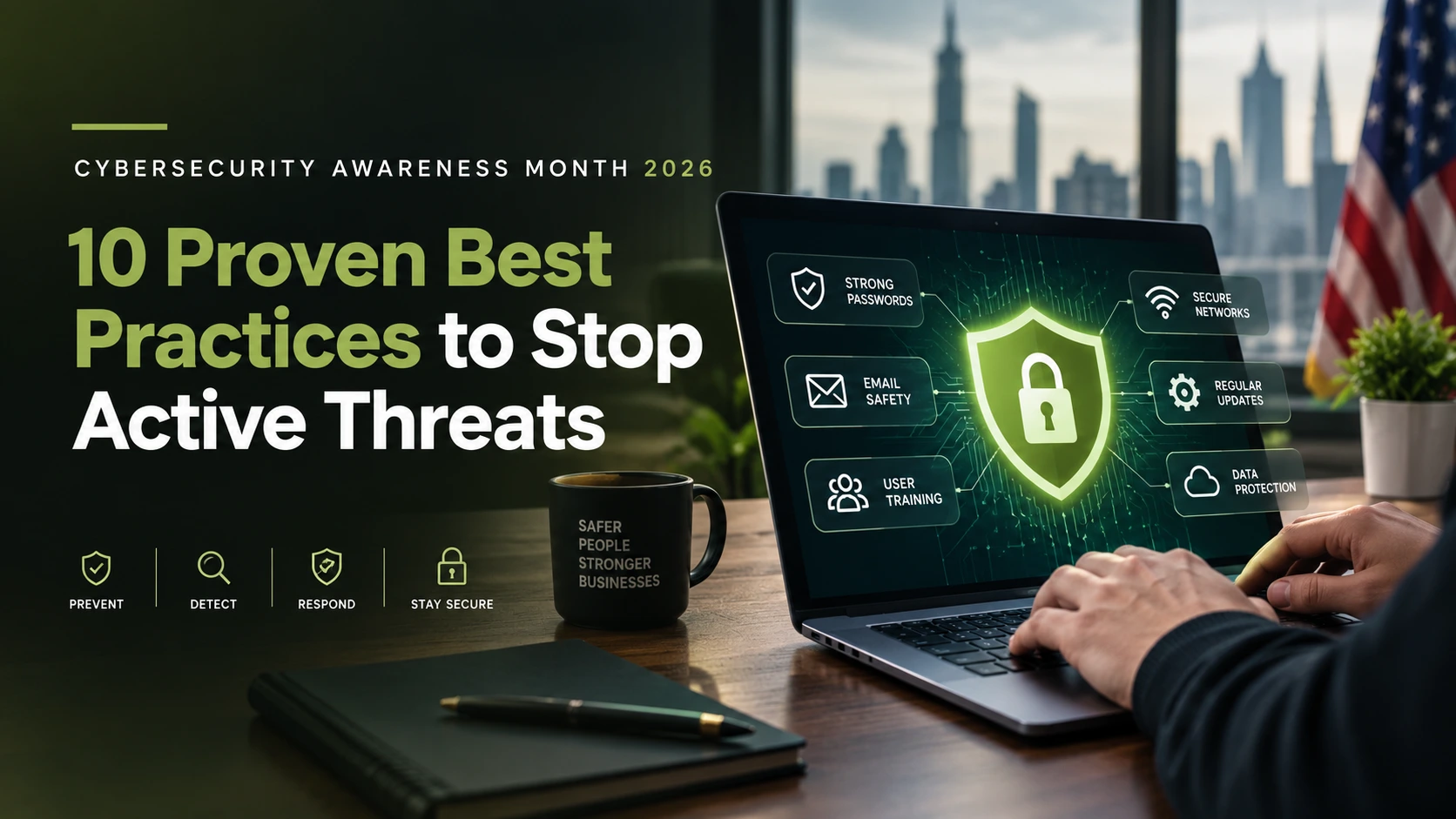
Cybersecurity Awareness Month 2026 is here, but attackers are not taking October off. While teams print posters and book webinars, criminals are exploiting unpatched edge devices, sending AI-written phishing emails and deploying ransomware through collaboration platforms.
This guide turns cybersecurity awareness month 2026 into a prioritized defense plan you can start today. You will get the official theme, the threats that matter right now and a 10-step checklist for individuals and businesses.
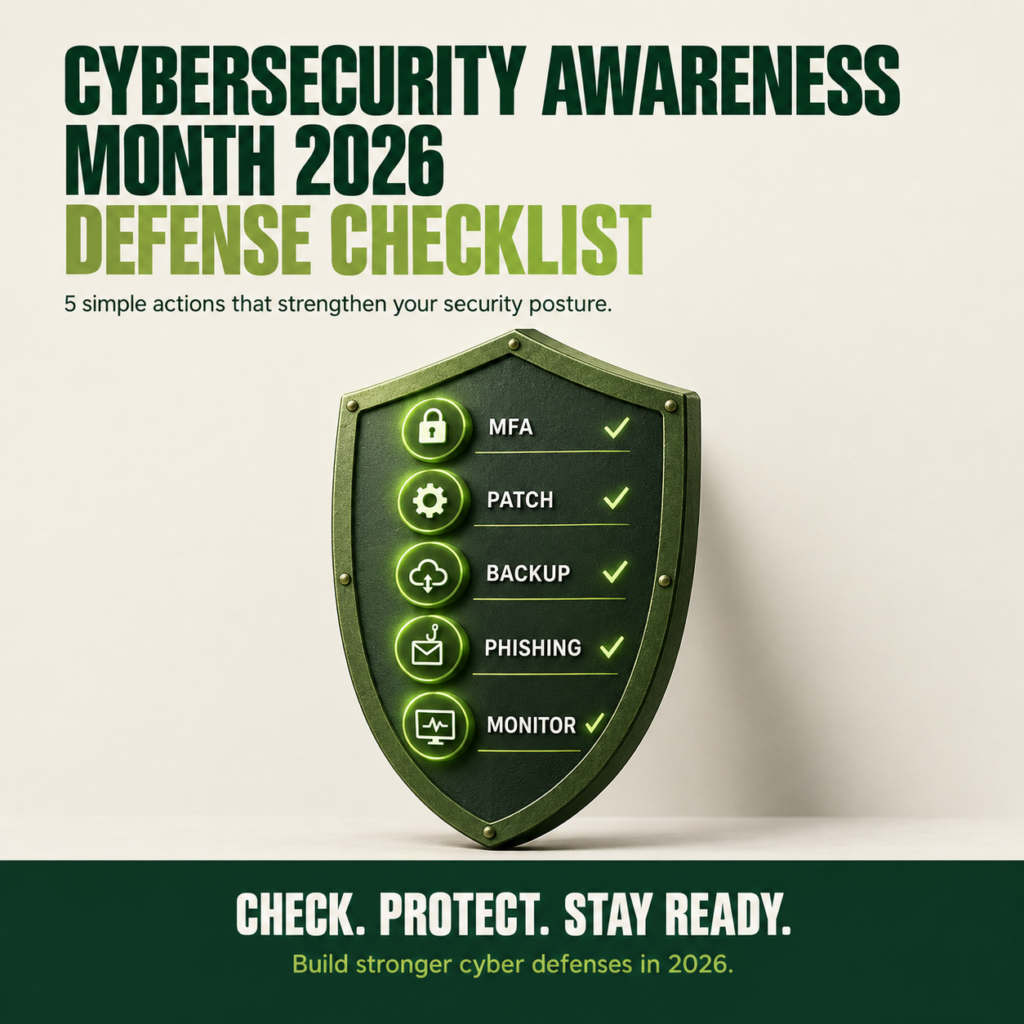
Table of Contents
1. What Is Cybersecurity Awareness Month 2026?
Cybersecurity Awareness Month runs every October. It began in 2003 as a joint effort between the National Cybersecurity Alliance and the U.S. Department of Homeland Security. Today the Cybersecurity and Infrastructure Security Agency (CISA) supports it alongside industry partners.
Cybersecurity Awareness Month 2026 runs from October 1 to October 31. The national theme is “Securing the Next 250,” a nod to the country’s 250th anniversary and a call to build a safer digital future.
The core message is simple: security is a shared responsibility. Think of it as a “don’t make it easy for them” mindset. Attackers choose the easiest target. Your job is to stop being it.
Why the 2026 Theme Matters
Past campaigns centered on four habits: strong passwords, multi-factor authentication, spotting phishing and updating software. Those habits still work. What changed is the speed of attacks. AI helps criminals write convincing lures in seconds.
2. Why Cybersecurity Awareness Month 2026 Matters for Businesses
Search interest in cybersecurity awareness month for businesses rises every October, and for good reason. A single clicked link can expose customer data, halt operations and trigger regulatory trouble.
Awareness alone does not stop every attack. It does reduce the easy wins attackers rely on. Use cybersecurity awareness month 2026 as a forcing function to:
- Review who has access to what.
- Test whether your staff can spot a real attack.
- Confirm your systems are patched and your backups actually restore.
- Validate your defenses with an independent security test.
3. Active Threats to Watch During Cybersecurity Awareness Month 2026
Generic advice ignores what is happening right now. These four threat types deserve attention throughout cybersecurity awareness month 2026.
AI-Powered Phishing
To protect against AI powered phishing 2026, you first need to understand the shift. Old phishing emails were full of typos. Today’s are polished, personalized and sometimes paired with cloned voices or fake video.
This is how AI is changing phishing strategies: attackers scrape public profiles, mimic your writing style and send messages that look like routine requests. Spear phishing now scales to thousands of targets.
Look for these signals in any sample phishing email:
- Unexpected urgency, such as “pay today” or “account locked.”
- A sender address that is slightly off.
- Requests to change payment details or share codes.
- Links that do not match the displayed text.
Reviewing real phishing email examples with your team is one of the cheapest awareness exercises you can run.
ClickFix Attacks
ClickFix attack prevention is now a training priority. In a ClickFix attack, a fake error message or CAPTCHA tells the user to paste a command into their own computer to “fix” the problem. The user runs the malware themselves, which bypasses many email filters.
Teach one rule: never paste commands from a website or pop-up into your system. Legitimate sites never ask for this.
Zero-Day Exploits on Edge Devices
Network appliances such as Citrix NetScaler gateways sit on the internet’s front door, which makes them prime targets. A zero day exploit has no patch when attackers start using it, so citrix netscaler zero day awareness matters for any organization running remote-access gateways.
Strong vulnerability management shortens your exposure window. Check the CISA Known Exploited Vulnerabilities catalog regularly and patch those items first. Newer platforms, including AI tooling in development pipelines, also deserve a place in your asset inventory.
Ransomware
Attackers keep finding new entry points, including collaboration servers and unpatched software. Ransomware groups such as Warlock have targeted organizations this way. These ransomware protection tips october 2026 apply every month:
- Keep offline or immutable backups.
- Restrict administrator accounts.
- Segment your network.
- Rehearse your restore process.
The CISA #StopRansomware guide is a solid free reference. If you are already hit, specialist ransomware recovery services can help, but prevention costs far less.
4. Cybersecurity Awareness Month Tips Everyone Can Use
These cybersecurity awareness month tips work at home and at the office. They also answer the common question of how to stay safe online during cybersecurity awareness month.
- Use a password manager and long, unique passphrases.
- Turn on multi-factor authentication for email, banking and work accounts.
- Pause before clicking links or opening attachments.
- Install updates as soon as they are available.
- Report suspicious messages instead of deleting them.
- Back up important files and test the restore.
Employees often search for the cyber awareness challenge 2026 to complete mandatory training. Whether your team uses that program or another, pair it with live exercises.
5. Cybersecurity Awareness Month 2026 Checklist: 10 Best Practices
This is the heart of the post. These cybersecurity awareness month best practices 2026 are ordered by impact. Use the cybersecurity awareness month checklist below as your working plan.
1. Enforce Multi-Factor Authentication Everywhere
Multi factor authentication blocks most credential-theft attacks. Prioritize email, VPN, admin accounts and cloud consoles. Prefer authenticator apps or hardware keys over SMS codes. See NIST’s digital identity guidance for authentication levels.
2. Patch Known Exploited Vulnerabilities First
Rank patches by real-world exploitation, not just severity score. Edge devices and remote-access tools come first.
3. Run Phishing Simulations
Wondering how does phishing simulation work? You send safe, fake phishing emails to staff, track who clicks and follow up with short coaching. Do it monthly, not once a year. Add anti phishing software to filter threats before they arrive. The Anti-Phishing Working Group publishes useful trend data.
4. Train Staff on ClickFix and Deepfakes
Add short modules on fake CAPTCHAs, voice cloning and video impersonation. Set a callback rule for any payment or credential request.
5. Build and Test Backups
Keep at least one backup disconnected from your network. Test restores quarterly. This is the single best ransomware safety net.
6. Map Your Attack Surface
You cannot protect assets you do not know about. List domains, servers, cloud services and third-party tools. A network security assessment and a cloud security assessment reveal forgotten systems.
7. Schedule External Penetration Testing
External penetration testing simulates an attacker coming from the internet. It checks whether your public systems can be exploited, which is exactly what real attackers do first.
8. Test Your Web Applications
Web application penetration testing uncovers flaws such as injection, broken access control and weak sessions. Use the OWASP Top 10 as a baseline.
9. Assess Internal Infrastructure
Internal infrastructure penetration testing shows how far an attacker can move after getting a foothold, for example through a phished laptop.
10. Write and Rehearse an Incident Response Plan
Know who decides, who communicates and who calls the vendors. Run a tabletop exercise this month.
Priority Table
| Priority | Action | Effort | Impact |
|---|---|---|---|
| 1 | Multi-factor authentication | Low | Very high |
| 2 | Patch exploited vulnerabilities | Medium | Very high |
| 3 | Offline backups and restore tests | Medium | Very high |
| 4 | Phishing simulation and training | Low | High |
| 5 | External and web app penetration testing | Medium | High |
| 6 | Internal testing and cloud assessment | Medium | High |
| 7 | Incident response rehearsal | Low | High |
6. Why Penetration Testing Belongs in Cybersecurity Awareness Month 2026
Awareness trains people. Testing proves your systems hold up. Cybersecurity awareness month 2026 is the ideal moment to add technical validation to your people-focused efforts.
Why Penetration Testing Is Important
Why penetration testing is important comes down to one point: it finds exploitable weaknesses before criminals do. Also known as ethical hacking penetration testing, it mimics real attacks under controlled conditions. The NIST SP 800-115 guide describes the technical approach.
A vulnerability assessment lists weaknesses. A pentest goes further and tries to exploit them. A red team exercise goes further still, testing your detection and response too.
Internal vs External Pen Testing
The difference in internal vs external pen testing is the attacker’s starting point. External tests start from the internet. Internal tests assume the attacker is already inside. Most organizations need both.
Scope, Rules and Life Cycle
Every engagement begins with penetration testing scope and penetration testing rules of engagement. These define what is tested, when, and what is off limits. The penetration testing life cycle typically runs through planning, reconnaissance, exploitation, reporting and penetration testing remediation with a retest.
A good pentest plan also covers cloud, APIs and remote penetration testing for distributed teams.
How Often and How Long
Many teams ask how often should penetration testing be done. At minimum, test annually and after major changes. High-risk systems benefit from continuous pentest programs. As for how long does a penetration test take, most engagements run from several days to a few weeks depending on scope.
Manual, Automated and Compliance Testing
Automated penetration testing is good for speed and coverage. Manual testing finds business-logic flaws that tools miss. The best programs combine both. Teams building software should add devsecops penetration testing to their pipelines.
Compliance penetration testing supports frameworks like PCI DSS, ISO 27001 and SOC 2. A third party penetration test also gives customers and auditors independent evidence. When requesting penetration testing quotes, compare scope, methodology and retest policy, not just price.
For a full-service option, see our vulnerability assessment and penetration testing (VAPT) services.
7. Your 30-Day Action Plan
Turn cybersecurity awareness month 2026 into measurable results:
- Week 1: Enable multi-factor authentication, inventory assets and review admin accounts.
- Week 2: Patch known exploited vulnerabilities and test your backups.
- Week 3: Run a phishing simulation and a ClickFix training session.
- Week 4: Book penetration testing, hold an incident response drill and document lessons learned.
Repeat the cycle every quarter. Awareness works best as a habit, not an event.
8. FAQ
What is Cybersecurity Awareness Month 2026?
Cybersecurity Awareness Month 2026 is the annual October campaign led by CISA and the National Cybersecurity Alliance. It promotes safer online habits for individuals and organizations. The 2026 theme is “Securing the Next 250.”
When does Cybersecurity Awareness Month 2026 start and end?
It starts October 1 and ends October 31, 2026.
How can businesses take part in Cybersecurity Awareness Month 2026?
Run employee training, phishing simulations and a patch review. Add technical validation through penetration testing and a vulnerability assessment.
What is the best defense against AI phishing?
Combine multi-factor authentication, email filtering, verification callbacks and regular training with realistic examples.
Is penetration testing part of cybersecurity awareness?
Yes. Awareness changes behavior, and penetration testing verifies that your technology and processes hold up under attack. Together they cover people and systems.
How often should I test my security?
Test at least once a year and after major system changes. Critical systems may need continuous testing.
9. Conclusion
Cybersecurity Awareness Month 2026 is more than a calendar event. It is a chance to cut risk before attackers find the gap. Turn on multi-factor authentication, patch exploited flaws, train your people and verify your defenses with testing.
Don’t make it easy for them.
Ready to Test Your Defenses?
Awareness is the start. Proof is the finish. Book your VAPT assessment today and find out what attackers would find before they do.