An AI voice clone scam begins with a phone call that sounds exactly like someone you love. Your “daughter” is crying. Your “boss” needs an urgent wire transfer. Your “grandson” is in trouble and begs you not to tell his parents. The voice is perfect, but it’s a fake, and the person on the line is a criminal.
Scammers can now build a convincing copy of a voice from a very short audio clip, often just a few seconds pulled from a social media video or voicemail greeting. That’s why the AI voice clone scam has become one of the fastest-growing fraud tactics for families and businesses alike.
This guide gives you what most pages skip: a clear, step-by-step response. You’ll learn the seven warning signs, how to set up a family safe word in three steps, a business verification protocol, and exactly what to do in the first 10 minutes if you get the call.
What Is an AI Voice Clone Scam? (Explained in 60 Seconds)
An AI voice clone scam is a fraud in which criminals use artificial intelligence to copy a real person’s voice, then use that fake voice to trick someone into sending money, sharing codes or handing over sensitive information.
Here is how it works in plain English:
- Collect. The scammer finds a short audio sample online, such as a TikTok, an Instagram Reel, a YouTube clip, a podcast or a voicemail greeting.
- Clone. AI software analyzes the pitch, accent and rhythm of that voice and generates new speech in the same style.
- Call. The scammer phones the target, either playing pre-written lines or typing live while the software speaks in the cloned voice.
- Pressure. A fabricated emergency forces a quick decision before the victim can think.
The technology is cheap, widely available and getting better every month. You don’t need to be famous to be a target, because anyone with a public video can be cloned.
A voice clone scam is also a form of vishing (voice phishing), the same family of attacks the FBI has warned about alongside smishing (text-message phishing). If you’ve studied phishing email examples, you already know the pattern: urgency, authority and a request that bypasses normal checks. The voice just makes it feel more real.
Why the AI Voice Clone Scam Works So Well
Social engineering succeeds because it targets emotion, not technology. A cloned voice adds a powerful trigger: you instinctively trust a voice you know.
Three things make the AI voice clone scam effective:
- Panic overrides logic. When a “loved one” is in danger, the brain prioritizes action over analysis.
- Caller ID can be faked. Spoofing makes the call appear to come from a familiar number.
- Scammers rehearse. They use short calls, background noise and crying to hide imperfections in the cloned audio.
AI Voice Clone Scam vs. Deepfake Scam: What’s the Difference?
A deepfake scam is the broader category. It includes fake video, fake images and fake audio. A voice clone scam is the audio-only version, and it’s the most common for phone fraud because it needs no video and very little source material. The “hacker AI” tools behind both are increasingly easy to find, which is why every family and business needs a plan rather than a hope of spotting the fake by ear alone.
7 Warning Signs of an AI Voice Clone Scam
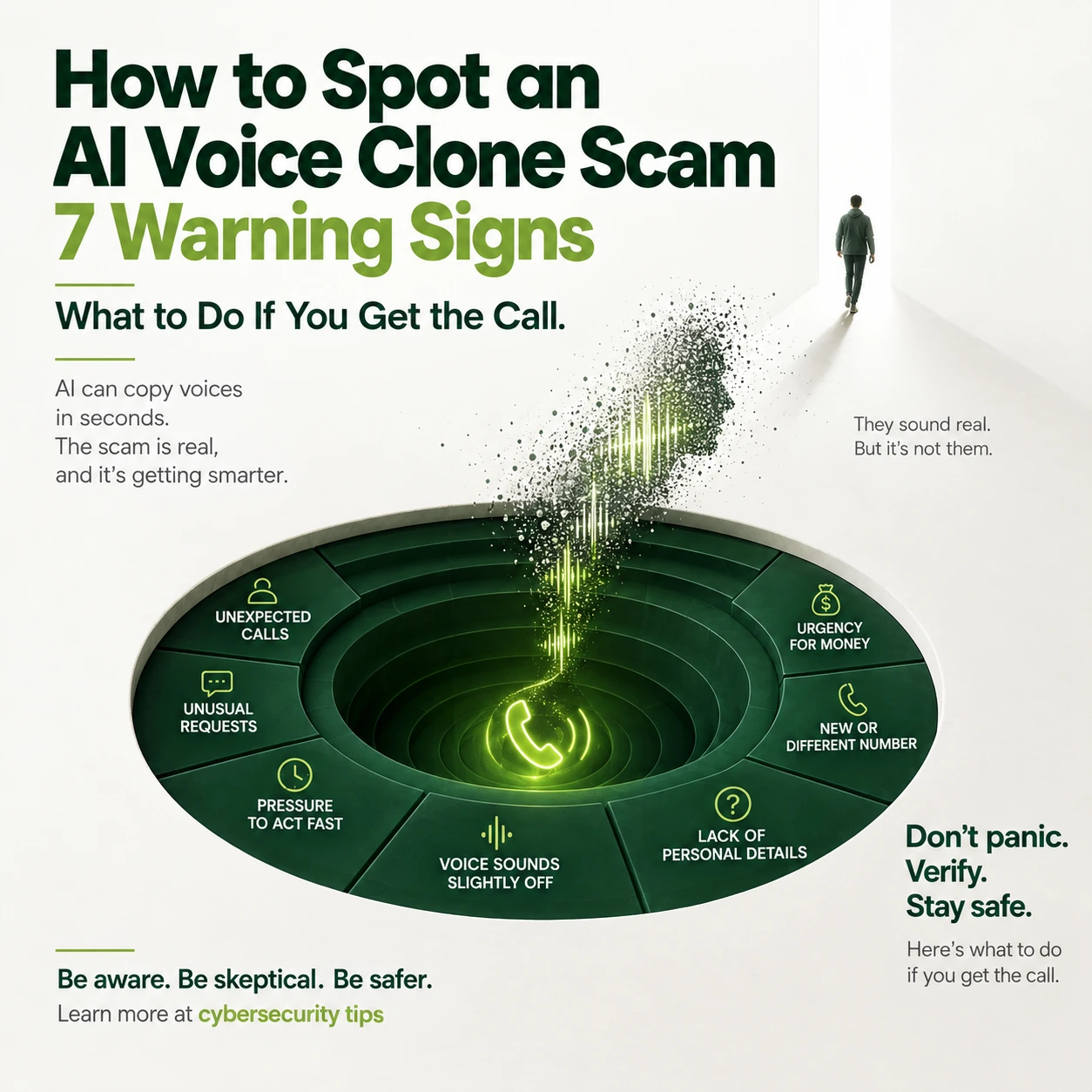
No single sign proves a call is fake, but two or more should make you stop. Here are the seven warning signs of an AI voice clone scam.
1. Extreme urgency
“I need money right now.” “Don’t hang up.” “There’s no time.” Real emergencies exist, but scammers manufacture urgency so you can’t verify. Any demand to act in minutes is a red flag.
2. Unusual payment methods
Gift cards, cryptocurrency, wire transfers, payment apps or cash couriers are the favorites. Legitimate emergencies rarely require untraceable payment, so treat these requests as an automatic warning.
3. A call that refuses video
If you say “Let’s switch to a video call” and the caller makes excuses (“my phone is broken,” “I can’t right now”), be suspicious. Real-time video deepfakes exist, but most phone scams stay audio-only.
4. Odd pauses, breathing or rhythm
Cloned speech can have unnatural gaps, a flat emotional tone, strange breathing or repeated phrases. Live voice conversion can add a slight delay between your question and the answer.
5. A request for secrecy
“Don’t tell Mom.” “Keep this between us.” Isolation is a classic manipulation tactic. A secrecy demand is one of the clearest signs of an AI scam phone call.
6. Caller can’t answer a personal question
Ask something only the real person would know, such as the name of a childhood pet or what you had for dinner on Sunday. Scammers working from social media may know public facts but stumble on private ones.
7. Emotion without detail
Crying, screaming and muffled speech can hide audio flaws. If the caller gives vague details (“I was in an accident, I can’t explain”) but a very specific payment instruction, hang up and verify.
[Insert checklist infographic here. Alt text: AI voice clone scam 7-point checklist infographic]
Real-World Examples: Grandparent, Kidnapping and CEO Fraud Calls
Seeing how the AI voice clone scam plays out makes it easier to recognize. Here are the three most common scripts.
The Grandparent Scam AI Voice Call
An older adult gets a call from a “grandchild”: “Grandma, it’s me. I’ve been arrested and I need bail money. Please don’t tell Dad.” A second “lawyer” or “officer” then takes over and gives payment instructions. The grandparent scam AI voice version is more convincing than the old one because the voice now matches. Consumer-protection agencies like the FTC have specifically warned about family-emergency schemes that use cloned voices (see the FTC consumer alert on voice cloning).
The Fake Kidnapping Call AI Voice Scam
A parent hears their child sobbing: “Mom, they’ve taken me!” A stranger demands ransom and warns the parent not to call anyone. In reality the child is safe at school. The fake kidnapping call AI voice scam relies on shock and isolation. The first step is always the same: contact the supposedly kidnapped person directly (text, another phone, a friend nearby) while someone else keeps the caller talking.
CEO Fraud Deepfake Voice Attacks
An accountant receives a call from the “CEO”: “I’m in a meeting. Wire the vendor payment today, and I’ll send the invoice later.” This CEO fraud deepfake voice attack, a form of business email compromise (BEC) moved to the phone, targets finance teams and executive assistants. The FBI’s Internet Crime Complaint Center has published alerts about criminals using generative AI for fraud, which you can read at the FBI IC3 website.
How to Detect Deepfake Voice Audio
If you’re wondering how to detect deepfake voice calls, the honest answer is this: your ears alone are not reliable. As the technology improves, audio flaws disappear. Use process, not instinct, as your defense.
Still, these checks help:
- Listen for consistency. Does the emotion match the words? Do the background sounds loop or cut out?
- Ask unexpected questions. Cloned voices handle scripted lines better than improvisation.
- Request a different channel. Say “I’ll call you right back” and hang up, then call the person’s saved number.
- Use video, but don’t rely on it. A live video call is a strong check, but video deepfakes are growing too.
- Trust verification over recognition. “It sounded exactly like him” is no longer proof.
How to Verify a Caller Is Real (3 Fast Methods)
- Hang up and call back using a number you already have saved, never the number that called you.
- Use a pre-agreed code word (see the next section).
- Contact them through another channel such as text, a messaging app or a mutual contact.
These three steps answer the question “how to verify a caller is real” better than any detection software. Technology can help (many companies now use AI threat detection tools and anti-phishing software), but a calm call-back beats any gadget.
Family Safe Word for Scams: 3-Step Setup
A family safe word for scams is the simplest, cheapest and most effective defense against an AI voice clone scam. It costs nothing, takes five minutes, and defeats a cloned voice completely, because a machine can copy a voice but cannot guess a secret.
Step 1: Choose a word nobody could guess
Pick a random, memorable word or short phrase that has never appeared online. Avoid pet names, birthdays, street names or anything visible on social media. “Purple tractor lemon” beats “Fluffy2010.”
Step 2: Share it only in person
Tell every family member face-to-face, including children and grandparents. Don’t text it, email it or post it. If it’s written anywhere, keep it offline.
Step 3: Agree on the rules
- Anyone claiming an emergency must give the word.
- If the caller can’t say it, hang up and call back on a saved number.
- A real family member in real danger will understand the check. Make that clear in advance.
- Change the word if it’s ever shared by accident, and review it twice a year.
Pro tip: Run a short “fire drill.” Have a relative call and ask for money, and see whether everyone remembers to ask for the word. Practice beats theory.
Business Protocol: Stop CEO Fraud Deepfake Voice Attacks
For companies, an AI voice clone scam is a payment-control problem, not a technology problem. Here is a protocol that works for small and mid-sized businesses.
The Wire-Transfer Verification Protocol
- Never act on a voice or voicemail alone. Any request for money, credentials or sensitive data must be confirmed on a second channel.
- Callback verification. Call the requester back using the number in your internal directory, not the one provided in the message.
- Two-person approval rule. No transfer above a set limit is released without two independent approvers.
- Cooling-off period for new payees. Delay first-time payments to new accounts by a set time, such as 24 hours, for verification.
- Code phrases for executives. Leadership and finance teams can use a rotating verification phrase for urgent requests.
- Written policy. Document it, train on it, and include a vishing policy for employees so nobody feels awkward questioning the “boss.”
Test Your People, Not Just Your Software
A policy is only useful if employees follow it under pressure. The only way to know is to test it. A professional social engineering penetration testing engagement simulates vishing calls, spear phishing emails and impersonation attempts against your team, then shows exactly where your process breaks.
This is the human side of penetration testing. A good engagement also covers technical weak points:
- External penetration testing examines what an attacker can reach from the internet, such as exposed services, leaked credentials and email systems that make impersonation easier.
- Internal testing shows what happens if one employee account is compromised. Comparing internal vs external pen testing helps you decide where to start.
- Web application penetration testing checks customer portals and payment pages that attackers use to pair a fake call with a real login.
- Automated penetration testing tools help with ongoing coverage, but they work best alongside manual ethical hacking penetration testing, because only a human tester can mimic a creative social engineer.
For a technical reference on how testing is structured, see the OWASP Web Security Testing Guide and NIST’s definition of penetration testing.
How Often Should Penetration Testing Be Done?
A good baseline is at least once a year, and after any major change such as a new application, a cloud migration or a merger. Regulated businesses often need testing for compliance penetration testing requirements (PCI DSS, ISO 27001, SOC 2, HIPAA). A defined penetration testing scope, rules of engagement and pentest plan keep the exercise safe and useful, and penetration testing remediation (fixing what’s found, then retesting) is where the real risk reduction happens.
Combine testing with ongoing vulnerability management, a network security assessment and a cloud security assessment, and you reduce the chances that a voice clone call is followed by an actual breach. Read more about our vulnerability assessment and penetration testing (VAPT) services.
What to Do in the First 10 Minutes of an AI Voice Clone Scam Call
If you’re asking “what to do if you get a scam call”, the first minutes matter most. Follow this timeline.
Minutes 0-2: Slow down and stay on script
- Don’t send money, codes or personal information.
- Say: “I’ll call you right back.” Then hang up. If the caller resists or threatens, that’s another warning sign.
Minutes 2-5: Verify independently
- Call the real person on a saved number, or text them.
- If it’s a family call, ask another relative to help while you keep the line open or call from a second phone.
- If it’s a business request, contact the executive through your internal directory.
Minutes 5-8: Protect your accounts and money
- If you already sent money, call your bank or card issuer immediately. For wires, ask for a “recall” request; speed improves the odds.
- For gift cards, call the card company right away.
- If you shared passwords or codes, change them now and turn on multi-factor authentication.
Minutes 8-10: Document and report
- Write down the phone number, time, what was said and payment details.
- Take screenshots of messages and call logs.
- Begin your report (next section).
How to Report an AI Voice Clone Scam
Reporting helps investigators spot patterns and may help recover funds. Report to:
- FTC: ReportFraud.ftc.gov for any scam call.
- FBI IC3: ic3.gov, especially for wire fraud, business losses or large amounts.
- Your bank or payment provider: to freeze or recall funds.
- Local police: especially for fake kidnapping calls.
- Your employer’s security team: for business-related calls.
If you receive repeated unwanted calls, the FCC also has guidance on blocking robocalls and spoofed calls. Outside the United States, contact your national cybercrime or consumer-protection authority.
How to Reduce Your Risk Going Forward
- Limit public voice and video posts, or tighten privacy settings.
- Change your voicemail greeting to a generic one.
- Turn on multi-factor authentication for banking and email.
- Hold a short “cyber awareness” talk with family and staff twice a year.
- Treat every urgent money request, from anyone, as unverified until proven otherwise.
[Insert 10-minute response plan image here. Alt text: How to stop an AI voice clone scam: 10-minute response plan]
Video suggestion: Embed a one-minute explainer, “How to Spot an AI Voice Clone Scam,” on this page, and publish the same clip as a Reel/Short with a link back to this article.
Protect Your Business Before the Next AI Voice Clone Scam Call
Families can defend themselves with a safe word. Businesses need more: tested processes, trained staff and secure systems. An AI voice clone scam only works when there’s a gap, whether that’s a missing verification step, an exposed email system or an employee who has never been tested.
Nexus Web Security helps you find those gaps first. Our team delivers VAPT services that combine technical penetration testing, social engineering simulations and clear remediation guidance.
👉 Request your penetration testing quote today and find out whether your team would pass the call.
Frequently Asked Questions About the AI Voice Clone Scam
What is an AI voice clone scam?
An AI voice clone scam is a fraud in which criminals use artificial intelligence to copy someone’s voice and then use it in a phone call to demand money, passwords or sensitive information.
How do scammers clone a voice?
They collect a short audio sample from social media, voicemail or video, then feed it into AI software that generates new speech in the same voice. Some tools need only a few seconds of audio.
How can I tell if a call is an AI voice clone?
Look for urgency, unusual payment methods, refusal to switch to video, odd pauses and requests for secrecy. Then verify by hanging up and calling back on a saved number.
What is a family safe word for scams?
It’s a secret word or phrase agreed in person that family members use to confirm identity during an emergency call. If the caller can’t give it, treat the call as fake.
Can I detect a deepfake voice by ear?
Not reliably. Modern clones can be very convincing, so rely on verification steps rather than how a voice sounds.
What should I do if I get a scam call?
Don’t send money or share information. Hang up, verify the person through a saved number or another channel, and report the call to the FTC and, where money is involved, the FBI IC3.
Are grandparent scams using AI voices real?
Yes. Consumer-protection agencies have warned that scammers use cloned voices in family-emergency calls aimed at older adults.
How can businesses prevent CEO fraud with deepfake voice calls?
Use callback verification, a two-person approval rule for payments, a cooling-off period for new payees and regular security awareness training. Social engineering penetration testing shows whether these controls work under pressure.
How often should penetration testing be done?
At least annually, and after major system or business changes. Compliance frameworks may require more frequent testing.
Where do I report an AI voice clone scam?
Report to ReportFraud.ftc.gov, the FBI at ic3.gov, your bank, and local police if you feel threatened.
Final Takeaways
- An AI voice clone scam relies on urgency, so slow down.
- Hang up and call back on a number you already have.
- Set a family safe word this week.
- Use callback verification and two-person approval for every payment.
- Test your defenses with professional penetration testing.
Disclaimer: This article is for general educational purposes and is not legal or financial advice.