What Is Ransomware Protection?
Ransomware protection is the combination of tools, policies, and habits that stop cybercriminals from locking, stealing, or leaking your data for a payout. If you’ve ever wondered what is ransomware protection and whether your business actually has it, the honest answer for most companies is: partially. Ransomware protection isn’t one product you install it’s a layered strategy involving email security, endpoint detection, backups, employee training, and a tested response plan.
In 2025 alone, ransomware showed up in 44% of all data breaches, according to Verizon’s Data Breach Investigations Report and for small and midsize businesses, that number jumped to 88%. Total Assure reported that the number of ransomware attacks increased by 34% during the first three quarters of 2025 over the same period in 2024. That’s not a slowdown that’s an acceleration, and it’s exactly why ransomware protection can no longer be an afterthought heading into 2026.
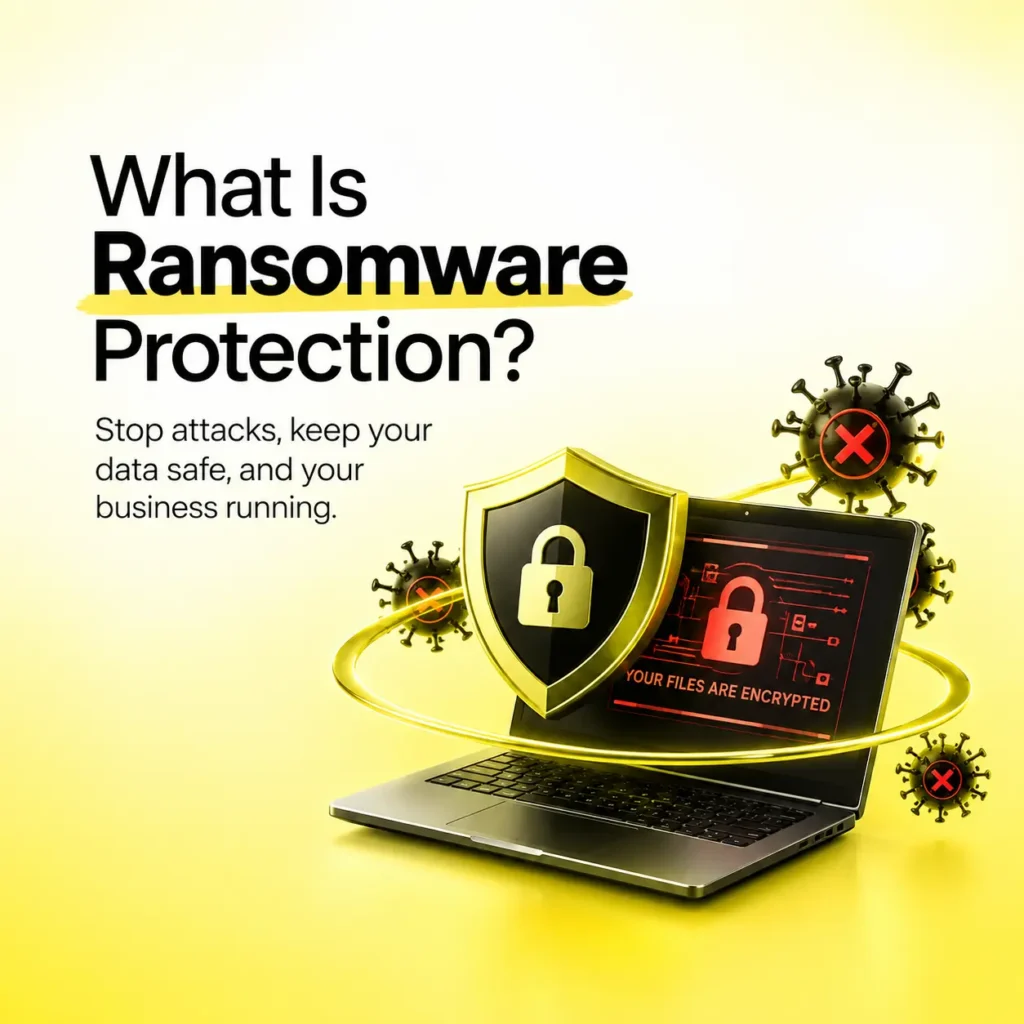
This guide walks through what ransomware protection actually means, why old advice (“just have backups”) is no longer enough, the specific layers you need, and how penetration testing fits into a modern ransomware protection strategy.
Why Ransomware Protection Looks Different in 2026
Ransomware protection strategies from even two years ago are already outdated. Here’s what changed:
1. Attackers Don’t Always Encrypt Anymore
Traditional ransomware protection focused almost entirely on backups if attackers encrypted your files, you’d just restore from a backup and move on. That logic is breaking down. As backup discipline improved industry-wide, ransom payment rates dropped from 76% in 2019 to just 28% in 2026, according to a 2026 threat report. In response, many groups have pivoted to data-extortion-only attacks they steal sensitive files and threaten to leak them publicly, whether or not they ever touch your encryption keys. Backups don’t stop that.
2. Supply Chain Attacks Multiply the Blast Radius
Instead of hitting one company, attackers compromise a single vendor and reach hundreds or thousands of downstream victims as seen in the MOVEit and Kaseya incidents. If your ransomware protection plan doesn’t account for third-party and vendor risk, you have a blind spot.
3. AI Is Sharpening the Attack
Attackers use GenAI tools to improve phishing lures, draft convincing emails, and support faster reconnaissance, meaning the “obviously fake” email is becoming rarer. Ransomware protection training has to evolve alongside this. techtarget
4. Ransomware-as-a-Service (RaaS) Lowers the Barrier
Ransomware protection used to assume attackers were sophisticated, well-resourced groups. Today, RaaS kits let low-skill criminals rent ready-made ransomware tools, dramatically expanding the pool of potential attackers targeting small and mid-sized businesses.
The Core Layers of Ransomware Protection
A real ransomware protection strategy is built in layers. If one fails, the next one catches the attack before it becomes a crisis.
Layer 1: Email and Phishing Defense
Since most ransomware still starts with a phishing email, this is the first and most important layer of ransomware protection. Look for:
- Advanced spam and phishing filters
- DMARC, SPF, and DKIM email authentication
- Simulated phishing tests for employees
Layer 2: Endpoint Detection and Response (EDR)
Traditional antivirus software catches known threats. Modern ransomware protection relies on EDR tools that watch for behavior like a process suddenly encrypting thousands of files and can automatically isolate the infected device before it spreads.
Layer 3: Network Segmentation
If one workstation gets infected, network segmentation limits how far the ransomware can travel. This single control has stopped countless attacks from turning into company-wide outages.
Layer 4: Immutable, Tested Backups
Backups remain essential to ransomware protection, but they need two upgrades most companies skip:
- Immutability backups that can’t be altered or deleted, even by an attacker with admin credentials.
- Regular restore testing a backup you’ve never tested restoring from is a backup you can’t trust in a crisis.
Layer 5: Identity and Access Management
Multi-factor authentication (MFA) and least-privilege access limit what a compromised account can actually do. A huge share of ransomware attacks succeeds because one overprivileged, unprotected login gave attackers the keys to everything.
Layer 6: Patch and Vulnerability Management
Unpatched software is one of the most common ransomware entry points. A disciplined patch management program, paired with regular vulnerability scanning, closes doors before attackers find them.
Layer 7: Incident Response Planning
Even the best ransomware protection can’t guarantee zero incidents. What separates a manageable event from a company-ending crisis is having a documented, rehearsed incident response plan who isolates systems, who calls legal counsel, who notifies customers, and in what order.
Layer 8: Employee Awareness Training
Technology stops most attacks, but people stop the ones that slip through. Ongoing, realistic training not a once-a-year slideshow keeps ransomware protection sharp against evolving phishing tactics.
Layer 9: Penetration Testing and Vulnerability Assessment
This is the layer most companies underinvest in, and it’s arguably the one that validates all the others.
Why Penetration Testing Is Central to Ransomware Protection
Firewalls, EDR, and backups are only as good as their weakest configuration, and you often don’t find that weakness until someone tries to exploit it. That’s the entire point of penetration testing.
Penetration testing (or “pentesting”) simulates a real ransomware attack in a controlled, authorized way. A skilled tester attempts the same techniques a ransomware group would use phishing simulations, external penetration testing against your internet-facing systems, internal infrastructure penetration testing to see how far an attacker could move once inside, and web application penetration testing to catch flaws in customer-facing apps and reports exactly where your ransomware protection would fail in a real incident.
Organizations that build a strong ransomware protection posture typically combine:
- External penetration testing testing what’s visible and attackable from outside your network
- Internal infrastructure penetration testing simulating what happens if an attacker (or infected device) is already inside
- Web application penetration testing probing your websites and portals for the vulnerabilities most often abused in supply chain and data-extortion attacks
- Vulnerability management as an ongoing program, not a one-time scan
- Compliance penetration testing for standards like ISO 27001, HIPAA, or PCI DSS, which increasingly require it
If your business hasn’t had a professional penetration testing engagement in the last 12 months, that’s a real gap in your ransomware protection strategy. Nexus Web Security’s VAPT (Vulnerability Assessment and Penetration Testing) serviceis built specifically to close this gap combining external, internal, and web application penetration testing with a clear, prioritized remediation report your team can act on immediately.
Ransomware Protection Checklist for 2026
Use this as a quick self-audit:
- Email filtering + DMARC/SPF/DKIM configured
- EDR deployed on all endpoints (not just legacy antivirus)
- Network segmented to contain lateral movement
- Immutable backups, tested quarterly
- MFA enforced everywhere, especially admin accounts
- Patch management program with defined SLAs
- Written, rehearsed incident response plan
- Employee phishing simulations run regularly
- Annual (minimum) penetration testing and vulnerability assessment
- Vendor/supply chain risk reviewed
Should You Pay the Ransom?
This is one of the most common questions in any ransomware protection conversation, and there’s no universally “right” answer but here’s what to weigh:
- Paying does not guarantee you’ll get a working decryption key, or that stolen data won’t still be leaked.
- Some jurisdictions restrict or penalize ransom payments to sanctioned entities.
- Cyber insurance policies increasingly dictate specific steps you must follow before or instead of paying.
- Every payment funds the ransomware economy and can mark you as a “payer” for future attacks.
This is a decision that should involve legal counsel, your incident response team, and your cyber insurance provider not something decided in the panic of the moment.
Frequently Asked Questions About Ransomware Protection
What is ransomware protection in simple terms?
Ransomware protection is the set of tools and practices email filtering, endpoint security, backups, employee training, and testing that work together to prevent ransomware attacks or limit their damage.
Is antivirus software enough for ransomware protection?
No. Antivirus software catches known malware signatures, but modern ransomware protection requires behavior-based EDR tools that can catch and stop new, previously unseen attack patterns.
How often should penetration testing be part of ransomware protection?
Most security frameworks and cyber insurance policies recommend penetration testing at least annually, and after any major infrastructure change.
Can small businesses afford real ransomware protection?
Yes many of the highest-impact steps (MFA, employee training, backup testing) are low-cost. Ransomware protection scales to budget; the goal is layering what you can afford now and building from there.
Does cloud storage protect against ransomware?
Cloud storage helps, but only if it includes versioning and immutability. Standard cloud sync (like a basic shared drive) can actually sync encrypted, ransomed files if not configured correctly.
What’s the difference between ransomware protection and general cybersecurity?
Ransomware protection is a specific application of broader cybersecurity practices, tuned specifically against extortion-based attacks with heavier emphasis on backups, EDR, and incident response than general cybersecurity.
Get Your Ransomware Protection Gap Analysis
Ransomware protection isn’t something you set once and forget it’s tested by real attackers whether you’re ready or not. If you’re unsure where your business actually stands, the fastest way to find out is a professional assessment.
Book a free ransomware protection consultation with Nexus Web Security and get a clear, prioritized penetration testing report showing exactly where your defenses would hold and where they wouldn’t.
This article is for informational purposes. For guidance specific to your organization’s compliance obligations or an active security incident, consult a qualified cybersecurity professional. Further reading: TechTarget — Ransomware Trends, Statistics and Facts in 2026, Splunk — Ransomware in 2026: Biggest Threats and Trends, Panda Security — 45 Ransomware Statistics Vital for Security in 2026.