
A cybersecurity budget decides whether your defenses stay ahead of attackers or fall one breach behind. Yet most guides only quote enterprise statistics and leave smaller teams guessing.
This guide gives you real benchmarks, a step-by-step planning framework, a vendor-neutral allocation model, and a clear place for penetration testing in your plan. It also covers the parts most articles skip: hidden costs, flat-budget trade-offs, and boardroom persuasion.
In this guide:
- What a cybersecurity budget includes
- 2026 benchmarks (including SMB numbers)
- How to build a cybersecurity budget from scratch
- Allocation: where the money should go
- Penetration testing as a budget line item
- Mapping spend to outcomes
- Hidden and soft costs
- What to cut when budgets freeze
- Justifying your cybersecurity budget to the board
- Compliance, AI and post-incident shifts
- FAQ
What Is a Cybersecurity Budget (and Why Is It Separate From IT Spend)?
A cybersecurity budget is the money set aside to prevent, detect, respond to and recover from cyber threats. It covers software, people, hardware, outsourced services, training and testing.
It should be tracked apart from general IT spend. IT keeps systems running. Security keeps them trusted. When the two share one line, security is the first thing cut in a lean quarter.
Ownership matters too. The CISO usually proposes the plan, the CFO scrutinizes it, and the board accepts the risk it leaves open.
Cybersecurity Budget Benchmarks for 2026
Current Gartner forecasts put global security spending near $240 billion in 2026, roughly 12.5% above 2025. Most enterprises spend 8–12% of total IT budget on security. High-threat sectors such as healthcare and finance often reach 10–15%.
Those numbers are useful, but they hide the small-company picture. Here is a practical translation using the same percentages:
- 20-person startup: With about $150,000 in annual IT spend, 8–12% is roughly $12,000–$18,000. That should go to MFA, endpoint protection, backups, and one annual security test.
- 200-person mid-market firm: With about $2 million in IT spend, 8–12% is $160,000–$240,000. This can fund a managed detection service, a vulnerability program and formal testing.
- Enterprise: Spending is typically well into seven figures, with dedicated teams and tooling.
These are illustrative starting points, not guarantees. Your risk profile should move the number up or down. Software now takes roughly 40% of security spend, ahead of personnel by about 11 percentage points.
How to Build a Cybersecurity Budget From Scratch
Follow these steps to build a defensible plan:
- Run a security risk assessment. List your crown jewels, threats and existing controls. A NIST-aligned approachkeeps this structured.
- Inventory assets and data. You cannot fund protection for systems you do not know exist.
- Rank risks by likelihood and impact. Fund the top of the list first.
- Map each control to a risk. Every dollar should reduce a named risk.
- Decide build, buy or outsource. Compare an in-house team with cybersecurity as a service or managed network security.
- Pick a method. Use zero-based budgeting when starting fresh and incremental budgeting when the program is mature.
- Plan multi-year. Spread large projects across fiscal years.
- Reserve contingency. Set aside 10–15% for incidents and emerging threats.
- Review quarterly. Threats move faster than annual cycles.
Small teams can follow the CISA cybersecurity resources for free guidance that matches most cybersecurity best practices for SMBs.
Cybersecurity Budget Allocation: Where Should the Money Go?
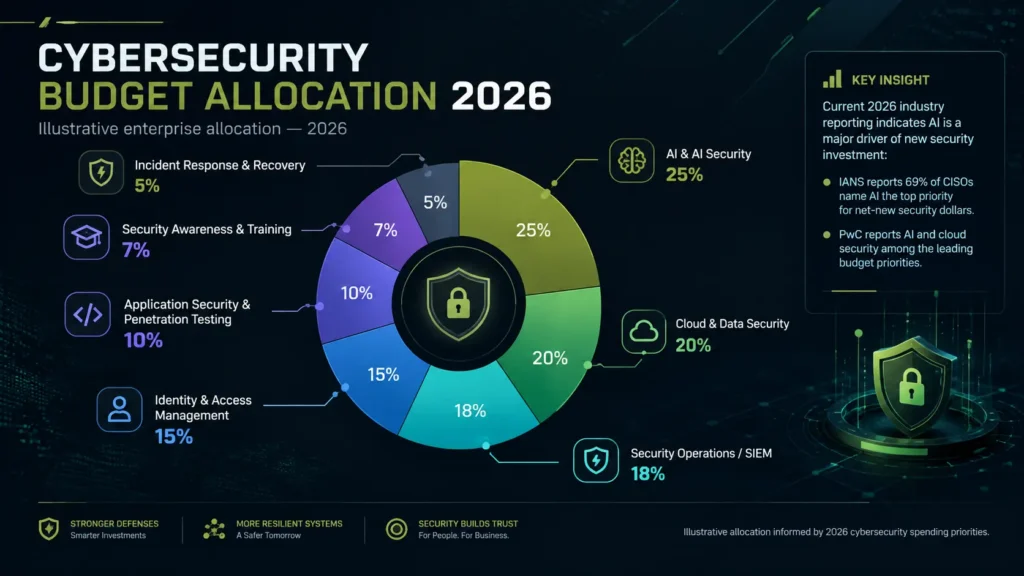
There is no universal split, but this vendor-neutral model is a sensible starting point for a mid-market company:
| Category | Suggested share | What it covers |
|---|---|---|
| Software and platforms | 35–40% | Endpoint, email, identity, SIEM, vulnerability management |
| Personnel | 25–30% | Security staff, training, certifications |
| Managed services | 15–20% | MDR, SOC monitoring, incident response retainer |
| Testing and assurance | 8–12% | Penetration testing, audits, red team exercises |
| Contingency | 5–10% | Incidents, urgent tooling, regulatory changes |
Watch for tool sprawl. Overlapping products and unused licenses are the most common source of waste. Consolidating vendors often frees budget without lowering protection.
![cybersecurity budget planning meeting with CFO]
Penetration Testing: The Line Item That Proves Your Cybersecurity Budget Works
Tools tell you what you bought. Penetration testing tells you whether it works. Ethical hackers simulate real attacks, so your team sees exactly how far an intruder could get.
The importance of penetration testing is simple: it converts abstract risk into evidence a CFO can act on. Professional penetration testing services also produce prioritized findings you can fund, fix and re-test.
Types of Penetration Testing to Budget For
- External penetration testing: Targets what attackers see from the internet, such as firewalls, mail servers and exposed apps.
- Internal infrastructure penetration testing: Assumes an attacker is already inside and checks lateral movement.
- Web application penetration testing: Tests logins, APIs and business logic against the OWASP Top 10.
- Cloud and network security assessment: Reviews configurations, identity and segmentation.
- Automated penetration testing and continuous pentest: Adds frequent scans between manual engagements.
- Remote penetration testing: Delivered without on-site presence, which lowers travel cost.
Understanding internal vs external pen testing helps you avoid paying twice for the same coverage. Most programs need both, but not always in the same quarter.
How Often Should Penetration Testing Be Done?
Test at least annually, and after major releases, infrastructure changes or acquisitions. Regulated firms often test more often. If you ship code weekly, pair yearly manual tests with DevSecOps penetration testing and automated checks.
How Long Does a Penetration Test Take?
Most engagements run from several days to a few weeks. The length depends on penetration testing scope, the number of applications and IPs, and the depth requested. Plan for reporting and retesting time too.
Scope, Rules of Engagement and Quotes
Every test needs a written scope and rules of engagement covering targets, testing windows and escalation contacts. Clear scope also makes penetration testing quotes comparable. Ask each provider for methodology, team credentials and a sample report. The NIST SP 800-115 guide is a good reference for what a solid methodology looks like.
Penetration Testing Remediation
A report that sits in a folder is wasted money. Reserve budget for penetration testing remediation, including developer time and a retest. As a rule of thumb, plan remediation effort in addition to the test fee itself.
Compliance Pentesting
Many frameworks expect independent testing. The PCI Security Standards Council requires it for cardholder environments, and ISO 27001 vulnerability management controls point the same way. If you need it for audits, budget for compliance penetration testing and, where auditors want independence, a third party penetration test.
Mapping Your Cybersecurity Budget to Outcomes
Most budgets list spend but never link it to results. Fix that with a simple mapping:
| Investment | Risk reduced | Proof metric |
|---|---|---|
| Multi-factor authentication | Credential theft | % accounts covered |
| Vulnerability management | Known exploits | Mean time to patch |
| Penetration testing | Unknown weaknesses | Critical findings closed |
| Email security and training | Phishing | Click rate, reports |
| Backups and recovery drills | Ransomware impact | Recovery time achieved |
Attach a number to each row. The story changes from “we bought tools” to “we cut critical exposure by 60% this year.”
Hidden and Soft Costs Most Budgets Miss
The true cost of security is more than licenses. Add these before you finalize:
- Training time and lost productivity
- Alert fatigue and the analyst hours it burns
- Integration and maintenance work between tools
- Turnover in a tight talent market
- Retesting, audit preparation and evidence collection
Including them makes your total cost of ownership more honest, and it prevents mid-year surprises.
What to Cut When Your Cybersecurity Budget Is Flat
Almost every guide assumes growth. Here is a defensible order when spend is frozen:
- Cut overlap first. Retire duplicate tools and shelfware.
- Renegotiate. Consolidate vendors and trade multi-year commitments for discounts.
- Automate. Automate vulnerability management to free analyst time.
- Protect the fundamentals. Never cut identity, patching, backups or monitoring.
- Right-size testing. Focus penetration testing on crown-jewel systems rather than everything.
If a cut raises risk, document it and get a named executive to accept that risk in writing.
How to Justify Your Cybersecurity Budget to the CFO and Board
Boards think in risk, revenue and reputation, not firewalls. Use this approach:
- Lead with business impact. Translate threats into downtime, fines and lost customers. The IBM Cost of a Data Breach report offers credible loss benchmarks.
- Show cost avoidance. Compare the price of controls with the expected cost of a breach.
- Use real incidents. Cite public events, such as the 2025 Kettering Health ransomware attack, to show operational impact.
- Benchmark against peers. Show where you sit against industry averages.
- Ask for a decision. Offer three options (minimum, recommended, full) so the board chooses instead of debating.
Pre-meet the CFO. Nobody likes surprises in the boardroom.
Compliance, AI and Post-Incident Shifts
Regulatory-Driven Budget Deltas
New rules add real cost. Frameworks such as DORA, NIS2, HIPAA and state privacy laws each require evidence, testing and reporting. For healthcare, the HHS HIPAA guidance sets the baseline. Estimate the incremental spend for security compliance and SOC compliance separately so it does not disappear inside general costs.
AI Is Competing for the Same Dollars
AI tools now compete with headcount and traditional controls. They can speed up detection, but they also add new attack surface. Approve AI security spend against measurable outcomes, not hype.
After a Breach: Reallocating Spend
Post-incident budgets tend to swing toward detection, response retainers and independent testing. Do not overreact with random tools. Use a fresh security risk assessment, then fund the gaps the incident actually exposed.
Choosing a Security Partner Without Vendor Bias
Whether you are choosing a managed provider or a cybersecurity services company, use neutral criteria:
- Clear scope and deliverables
- Certified testers and documented methodology
- Sample reports and references
- Transparent pricing with no lock-in
- Support for retesting and remediation guidance
Ask providers how their cyber security consulting services tie findings back to your budget priorities.
Cybersecurity Budget FAQ
How much should a company spend on cybersecurity?
Most organizations spend 8–12% of IT budget on security, and more in regulated sectors. Adjust for your risk, data sensitivity and compliance duties.
What percentage of IT budget should go to cybersecurity?
A common range is 8–12%, rising to 10–15% in healthcare and finance.
How do I create a cybersecurity budget?
Assess risk, inventory assets, rank threats, map controls to risks, choose build or outsource, and review quarterly.
How often should penetration testing be done?
At least once a year, plus after major changes. High-risk or regulated firms should test more often.
How long does a penetration test take?
Typically days to a few weeks depending on scope, plus time for reporting and retesting.
Is penetration testing part of the cybersecurity budget?
Yes. It sits under testing and assurance, and it validates that your other spending works.
Is cyber insurance part of the security budget?
Often it is tracked separately, but the two are linked. Stronger controls can improve insurability and premiums.
What should a small business prioritize on a limited budget?
Start with MFA, backups, endpoint protection, patching and staff training. Then add an annual penetration test on your most critical systems.
Conclusion: Make Every Dollar of Your Cybersecurity Budget Count
A strong cybersecurity budget is not the biggest one. It is the one tied to real risk, proven by testing and explained in language the board understands.
Start with a risk assessment, fund the fundamentals, and validate the result with independent testing.
Ready to Prove Your Security Spend Is Working?
Don’t guess whether your defenses hold up. Get a clear, prioritized view of your real exposure with expert vulnerability assessment and penetration testing from Nexus Web Security.
Request your VAPT quote today and turn your cybersecurity budget into measurable protection.