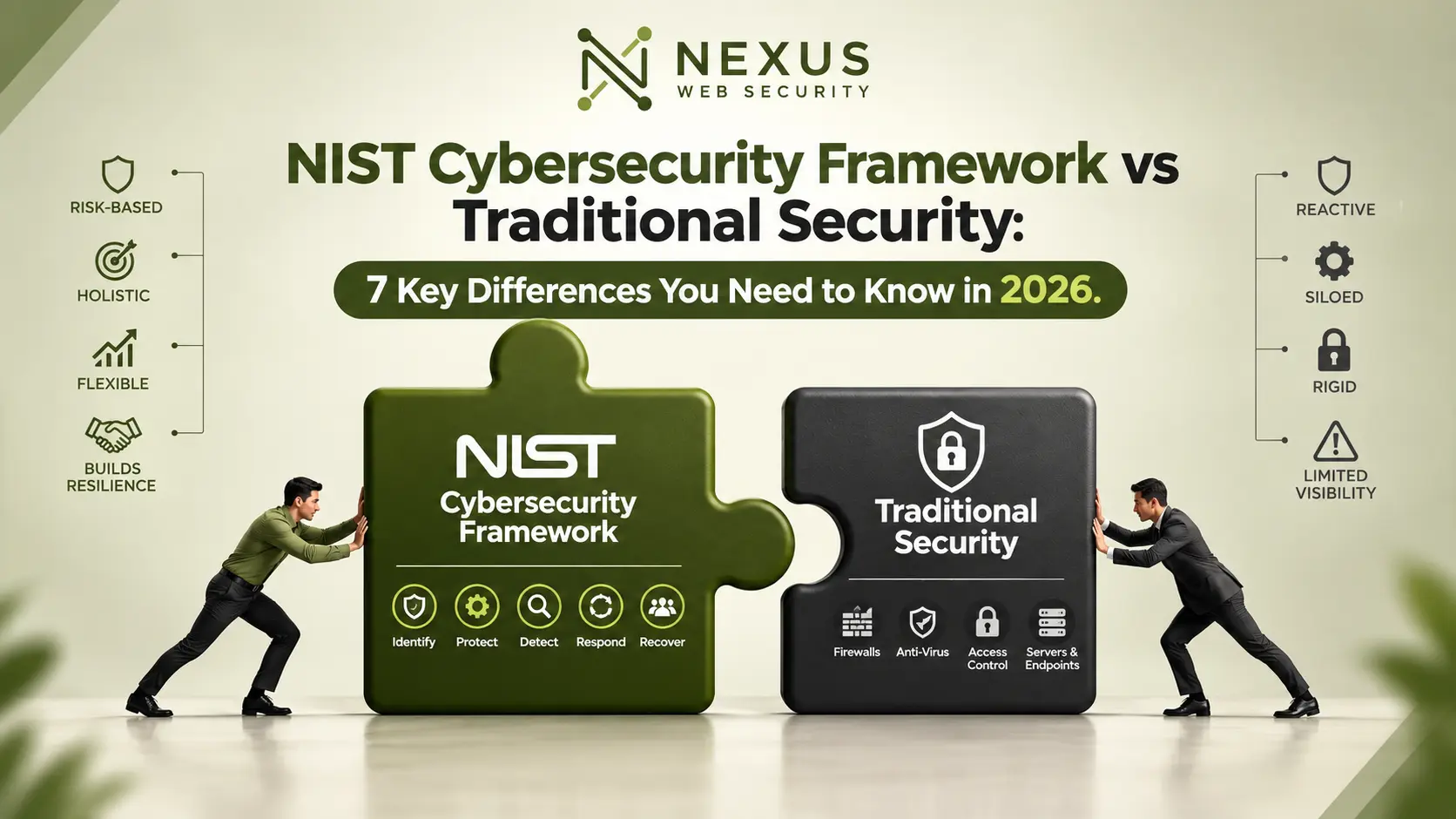
When most businesses talk about “cyber security,” they mean antivirus software, a firewall, and maybe an annual security risk assessment. That’s traditional security and it’s failing at an alarming rate. The NIST Cybersecurity Framework vs Traditional Security debate isn’t academic anymore; it’s the difference between a company that recovers from a breach in hours and one that closes its doors for good.
This guide breaks down exactly how the NIST Cybersecurity Framework vs Traditional Security models differ, what it actually costs to switch, and how to know which approach or combination is right for your organization.
Table of Contents
- What Is Traditional Security?
- What Is the NIST Cybersecurity Framework?
- NIST Cybersecurity Framework vs Traditional Security: The Core Differences
- NIST CSF’s 6 Functions vs Traditional Security’s Narrow Focus
- Cost & Resource Comparison
- NIST CSF vs ISO 27001 vs NIST 800-53 (Clearing Up the Confusion)
- Real-World Example: Moving From Traditional Security to a Risk-Based Model
- Is NIST CSF Right for Small Businesses?
- Penetration Testing: The Evidence Layer Behind Every Framework
- How Nexus Web Security Helps You Bridge the Gap
- FAQs
- Conclusion & Next Steps
1. What Is Traditional Security?
Traditional security is the “castle-and-moat” approach most companies have relied on for the past two decades. It’s built around security compliance checklists, perimeter tools, and reactive fixes rather than continuous risk management.
Typical components of traditional security include:
- Firewalls and antivirus software
- Annual security risk assessment or audit
- Manual patch management
- Point-in-time penetration testing with no follow-up plan
- Compliance treated as a once-a-year checkbox exercise (GDPR compliance, HIPAA compliance, PCI DSS compliance handled in isolation)
The problem? Traditional security assumes the perimeter holds. In a world of cloud infrastructure, remote work, and supply-chain attacks, that assumption breaks down fast.
2. What Is the NIST Cybersecurity Framework?
The NIST Cybersecurity Framework (CSF) is a voluntary cyber security framework developed by the U.S. National Institute of Standards and Technology. Instead of a static checklist, it treats cybersecurity as an ongoing risk management discipline one that changes as your business, threats, and technology evolve. The full CSF 2.0 documentation, quick-start guides, and profile templates are hosted directly on NIST’s official site.
CSF 2.0 (released in 2024) added a sixth function Govern making board-level accountability a formal part of the framework for the first time.
3. NIST Cybersecurity Framework vs Traditional Security: The Core Differences
Here’s the head-to-head breakdown of NIST Cybersecurity Framework vs Traditional Security:
| Factor | Traditional Security | NIST Cybersecurity Framework |
| Approach | Tool-driven, perimeter-based | Risk-based, outcome-driven |
| Posture | Reactive (respond after breach) | Proactive (continuous monitoring & improvement) |
| Scope | IT department only | Enterprise-wide, including leadership |
| Compliance | Checkbox, point-in-time | Ongoing, measurable via Tiers/Profiles |
| Flexibility | Rigid, vendor-locked | Adaptable to any industry or size |
| Maturity tracking | None | Built-in Tiers (Partial → Adaptive) |
| Governance | Rarely involves the board | Govern function requires leadership buy-in |
The single biggest shift is this: traditional security asks “do we have the right tools?” NIST CSF asks “do we understand our risk, and can we prove we’re managing it?”
4. NIST CSF’s 6 Functions vs Traditional Security’s Narrow Focus
Traditional security usually only touches two of the six functions NIST CSF requires:
- Govern – Leadership sets cybersecurity strategy and risk tolerance (almost entirely absent in traditional models)
- Identify – Know your assets, data, and risk exposure
- Protect – Firewalls, access control, encryption (this is where traditional security lives)
- Detect – Continuous monitoring, not just antivirus alerts
- Respond – A documented, tested incident response plan
- Recover – Business continuity and disaster recovery planning
Most companies relying on traditional security only have “Protect” and maybe a weak version of “Detect” covered. That leaves Govern, Identify, Respond, and Recover almost entirely exposed.
5. Cost & Resource Comparison
This is the gap most articles skip. Here’s a realistic breakdown:
Traditional Security (annual, SMB-scale)
- Antivirus/endpoint tools: $2,000–$8,000
- Firewall management: $3,000–$10,000
- One-time penetration testing: $5,000–$25,000
- Compliance audit (reactive): $10,000–$20,000
- Total: ~$20,000–$60,000/year, with no maturity tracking
NIST CSF-Aligned Program (SMB-scale)
- Gap assessment & Profile development: $8,000–$20,000
- Governance & policy documentation: $5,000–$15,000
- Continuous monitoring tools: $5,000–$15,000/year
- Ongoing compliance penetration testing & vulnerability assessment cycles: $10,000–$30,000/year
- Total: ~$30,000–$80,000/year, but with measurable maturity improvement and board-level visibility
The upfront delta is real typically 20–40% higher in year one but the ongoing cost gap narrows significantly by year two, once governance and monitoring processes are established. The bigger financial argument is breach-cost avoidance: IBM’s Cost of a Data Breach research consistently shows organizations with mature security frameworks and tested incident response plans save over $1 million per breach compared to those without one.
6. NIST CSF vs ISO 27001 vs NIST 800-53 (Clearing Up the Confusion)
This is one of the most searched and most poorly explained comparisons online.
- NIST CSF is a flexible, voluntary framework anyone can adopt. It tells you what outcomes to achieve.
- ISO 27001 is an international, certifiable standard with a formal audit and certificate. It tells you how to build a management system.
- NIST 800-53 is a detailed catalog of security controls, mostly mandatory for U.S. federal agencies and contractors. It tells you exactly which controls to implement.
In practice, many organizations use NIST CSF as the strategic umbrella, then pull specific controls from NIST 800-53 or CIS Controls, and pursue ISO 27001 certification if a client or regulator requires third-party proof.
7. Real-World Example: Moving From Traditional Security to a Risk-Based Model
A mid-sized fintech company running traditional security firewall, antivirus, annual audit suffered a phishing-driven breach that went undetected for 11 days because no continuous monitoring existed.
After the incident, the company:
- Ran a NIST CSF gap assessment (Identify function)
- Brought in leadership sign-off on risk tolerance (Govern function)
- Implemented continuous cyber threat detection and logging (Detect function)
- Built and tested a formal incident response runbook (Respond function)
- Added a validated disaster recovery plan with backup testing (Recover function)
Within 12 months, average detection time dropped from 11 days to under 4 hours, and the company passed its next SOC 2 compliance audit without a single major finding something it had failed the year before under the old model.
8. Is NIST CSF Right for Small Businesses?
Yes and this is one of the most underserved questions in search results. NIST CSF was intentionally designed to scale. Small businesses don’t need to implement every sub-category; they can build a lightweight Current Profile and a realistic Target Profile based on actual risk, not enterprise-scale ambition.
A practical SMB starting point:
- Start with a free cyber security risk assessment checklist for startups to identify your top 5 risks
- Focus first on Identify and Protect before expanding into Detect/Respond/Recover
- Use Tier 1 (Partial) as an honest starting point it’s not a failing grade, it’s a baseline
- Pair the framework with affordable, targeted vulnerability assessment and compliance penetration testing rather than a single generic annual test
9. Penetration Testing: The Evidence Layer Behind Every Framework
Whether you run traditional security or a full NIST CSF program, none of it means anything without proof that your defenses actually hold up. That proof comes from testing and this is where most companies get the terminology, cadence, and scope wrong.
What Counts as Penetration Testing (And Why the Type Matters)
Not all testing is the same. Depending on what you’re protecting, you’ll need a different type:
- External penetration testing simulates an attacker with no internal access, probing your public-facing systems.
- External infrastructure penetration testing and internal infrastructure penetration testing cover your network, servers, and endpoints from outside and inside the perimeter together these make up general infrastructure penetration testing and pentesting networkwork.
- Web application penetration testing, also written as penetration testing web applicationor penetration test web application, follows structured web application penetration testing methodology built on OWASP’s published guidance.
- Ethical hacking penetration testing is the broader discipline umbrella most people search for when they mean any of the above.
- DevSecOps penetration testing is integrated into CI/CD pipelines rather than run once a year, and increasingly overlaps with automated penetration testing tooling.
- Bank penetration testing and third party penetration test engagements are required by regulators or client contracts, often overlapping with compliance penetration testing,compliance pentesting, and dedicated compliance penetration testing services.
Why Penetration Testing Is Important
Why penetration testing is important comes down to one thing traditional security can’t offer on its own: evidence. Why web application penetration testing matters specifically is that most breaches today start at the application layer, not the network perimeter — firewalls simply don’t see that traffic. The importance of penetration testing as a discipline, and penetration testing in software testing cycles specifically, is exactly why it maps directly onto the Identify and Protect functions of NIST CSF: you can’t reduce a risk you haven’t measured.
How Often, How Long, and What It Actually Involves
Three questions come up in nearly every penetration testing scope conversation:
- How long does a penetration test take? Most external and internal engagements run 1–3 weeks depending on scope and complexity.
- How often should penetration testing be done? At minimum annually, but any organization running DevSecOps testing or a continuous pentest model tests every major release, not once a year.
- What does the penetration testing life cycle actually look like? Scoping and penetration testing rules of engagement, active testing, penetration testing remediation, and re-testing.
Skipping the remediation and re-test steps is the single biggest penetration testing risk most companies take — a report full of findings that never get fixed is not a security program.
Application-Based, Remote, and Compliance-Driven Testing
Modern engagements increasingly include:
- Application-based penetration test work for SaaS products and mobile apps, not just corporate networks.
- Remote penetration testing for distributed and hybrid teams, run entirely off-site.
- Internal pentesting services for insider-threat and lateral-movement scenarios.
- Structured penetration testing and vulnerability analysis reporting that feeds directly into your NIST CSF Identify and Protect profiles.
If you’re only budgeting for one-off, checkbox-style testing, you’re still operating inside the traditional security model even if you call it “compliance.” A properly scoped VAPT engagement replaces that one-time exercise with a repeatable, evidence-generating process your Govern function can actually act on.
10. How Nexus Web Security Helps You Bridge the Gap
Whether you’re still running a traditional, tool-only setup or actively building a NIST CSF-aligned program, the foundation of both models is the same: you can’t protect or govern what you haven’t tested. Our VAPT (Vulnerability Assessment and Penetration Testing) services map directly onto the Identify, Protect, and Detect functions of the NIST CSF giving you the evidence-based risk data your Govern function needs to make real decisions, not guesses.
11. FAQs
Is NIST CSF a replacement for traditional security tools?
No. NIST CSF doesn’t replace firewalls, antivirus, or endpoint detection it organizes them inside a risk-based strategy so leadership can see whether those tools are actually reducing risk.
Is the NIST Cybersecurity Framework mandatory?
For most private businesses, no it’s voluntary. However, it’s often required indirectly through client contracts, cyber insurance applications, or federal supply-chain requirements.
What’s the difference between NIST CSF and ISO 27001?
NIST CSF is a flexible, non-certifiable framework focused on outcomes; ISO 27001 is a certifiable international standard with a formal audit process.
Does NIST CSF apply to small businesses?
Yes. CSF was built to scale down to small teams using lightweight Profiles and Tiers, not just large enterprises.
How much does it cost to implement NIST CSF?
For an SMB, expect roughly $30,000–$80,000 in the first year, factoring in gap assessment, governance documentation, and ongoing monitoring see the full cost comparison above.
What’s the difference between NIST CSF and NIST 800-53?
NIST CSF defines high-level outcomes; NIST 800-53 is a detailed, mandatory control catalog primarily used by U.S. federal agencies and contractors.
How long does it take to implement NIST CSF?
A basic Current Profile and initial gap assessment typically takes 4–8 weeks; full maturity improvement across all six functions is usually a 12–18-month program.
12. Conclusion & Next Steps
The NIST Cybersecurity Framework vs Traditional Security comparison ultimately comes down to this: traditional security protects against yesterday’s threats, while NIST CSF builds the governance and visibility needed to handle tomorrows. You don’t have to choose one and abandon the other the smartest programs use CSF as the strategic backbone and keep proven tools like penetration testing and vulnerability assessments as the evidence layer underneath it.
Ready to see where your organization actually stands? Book a VAPT assessment with Nexus Web Security and get a clear, risk-based picture of your Identify and Protect posture — the exact foundation NIST CSF is built on.