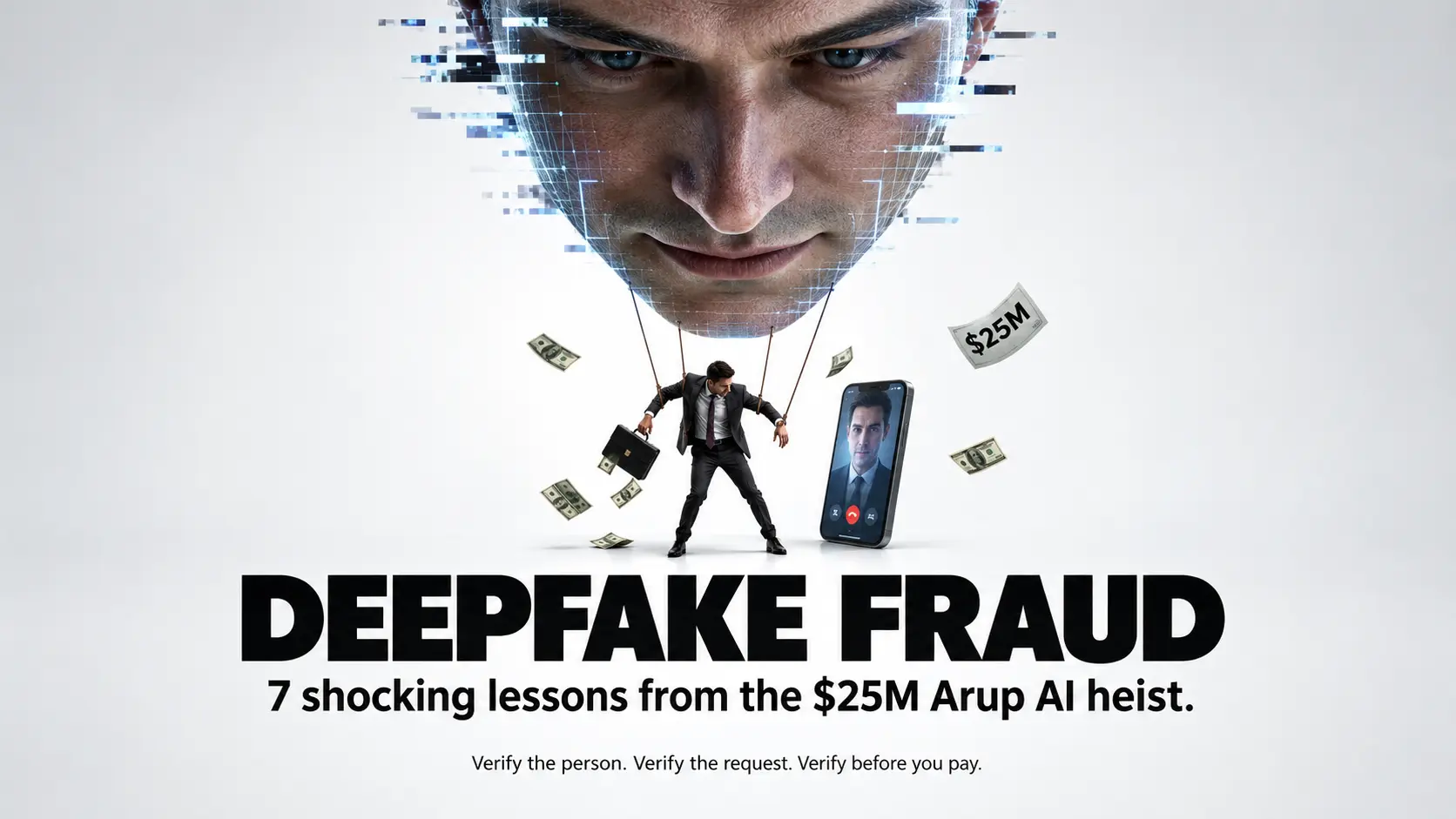
Deepfake fraud prevention is no longer optional for modern businesses. In January 2024, the multinational British engineering firm Arup lost approximately $25 million after criminals used AI-generated video and audio to impersonate its Chief Financial Officer during a live video call. This single incident changed how the world thinks about corporate cybersecurity, and it offers every organization large or small a masterclass in what happens when deepfake fraud prevention is treated as an afterthought.
In this guide, we break down exactly how the Arup heist happened, the technology behind it, real deepfake statistics, and the concrete steps your business can take starting today.
Table of Contents
- What Happened: The Arup Deepfake Heist Explained
- The Anatomy of the Attack
- The Technology Behind It
- Deepfake Statistics and the Scale of the Problem
- Deepfake Fraud Prevention Strategies That Actually Work
- Detection & Response Tools
- After the Money Moves: Wire Transfer Fraud Recovery
- Beyond Deepfakes: Synthetic Identity Fraud
- Why Penetration Testing Is Your First Line of Defense
- FAQs
1. What Happened: The Arup Deepfake Heist Explained
Arup is a 78-year-old London-based design and engineering firm behind projects like the Sydney Opera House. In early 2024, a finance employee in Arup’s Hong Kong office received an email that appeared to come from the company’s UK-based CFO, requesting a confidential, urgent transaction.
The employee was initially skeptical a healthy instinct that, on its own, wasn’t enough. Shortly after, the employee was invited to a video conference where several “colleagues,” including the CFO, appeared on screen. Every single person on that call was an AI-generated deepfake. Convinced by the realism of the meeting, the employee processed 15 separate transfers totaling roughly $25 million to five different Hong Kong bank accounts. Law enforcement agencies such as Interpol have flagged this style of attack as a fast-growing global threat.
2. The Anatomy of the Attack
Executive Phishing Attacks: The Opening Move
The scam began with a classic tactic: executive phishing attacks. A spoofed email, styled to look like it came directly from the CFO, created urgency and demanded discretion two hallmarks of nearly every successful spear phishing attacks campaign.
Deepfake Attacks on Zoom and Video Platforms
What made this different from typical fraud was the second stage. The attackers staged deepfake attacks on zoom-style video calls, using AI-generated likenesses of real executives built from publicly available conference footage, earnings calls, and LinkedIn videos. The FBI’s Internet Crime Complaint Center (IC3) has documented a sharp rise in this exact attack pattern across corporate finance departments worldwide.
AI-Enhanced Social Engineering and Synthetic Consensus
The most chilling detail: multiple fake “colleagues” appeared to agree with the request in real time. This is a textbook example of ai enhanced social engineering where synthetic social proof overrides an employee’s natural skepticism.
3. The Technology Behind It
Voice Cloning Attacks Explained
The realism of the call relied heavily on voice cloning attacks, where short audio clips from public speeches or interviews are used to train AI models that replicate a person’s tone, pacing, and speech patterns almost perfectly.
FraudGPT and the Rise of AI Phishing Attacks
Underground tools like fraudgpt have made it dramatically easier for criminals with no coding background to generate convincing ai phishing attacks, fake emails, and scripted deepfake dialogue. The Cybersecurity and Infrastructure Security Agency (CISA) warns that generative AI tools are lowering the technical barrier to entry for cybercrime at an alarming rate.
4. Deepfake Statistics and the Scale of the Problem
Recent deepfake statistics show a troubling trend: AI-generated fraud attempts against businesses have increased year over year, with finance and executive-impersonation scams among the fastest-growing categories. The Arup case is far from isolated it’s part of a wave of deepfake news scandals that have hit banks, retailers, and advertising firms alike, according to reporting highlighted by the World Economic Forum.
5. Deepfake Fraud Prevention Strategies That Actually Work
Effective deepfake fraud prevention isn’t about one tool it’s a layered defense.
Deepfake Phishing Protection for Employees
Train staff to treat urgent, confidential financial requests as red flags, regardless of how convincing the sender appears. Deepfake phishing protection should include mandatory callback verification using a pre-agreed phone number, never the number provided in the suspicious message.
Voice Biometrics Fraud Prevention
Some organizations are now deploying voice biometrics fraud prevention systems that flag synthetic audio patterns in real time, adding a technical layer beneath human judgment.
Banking Fraud Prevention and B2B Payment Fraud Prevention
Strong banking fraud prevention controls like dual authorization and mandatory holding periods for large transfers combined with dedicated b2b payment fraud prevention policies for vendor and executive payment requests, can stop a scam before funds ever leave the building. The Consumer Financial Protection Bureau offers useful guidance on structuring these internal controls.
6. Detection & Response Tools
Artificial Intelligence Fraud Detection
Modern artificial intelligence fraud detection platforms analyze transaction patterns, login behavior, and communication metadata to flag anomalies long before a human would notice.
Fraud Detection Analytics and AI Phishing Detection
Pairing fraud detection analytics with dedicated ai phishing detection software helps security teams catch spoofed domains and manipulated media before an employee ever clicks “join meeting.” The SANS Institute publishes regularly updated frameworks for building these detection pipelines.
7. After the Money Moves: Wire Transfer Fraud Recovery
Once funds are sent, options narrow quickly. Wire transfer fraud recovery depends heavily on speed the sooner a bank and law enforcement are notified, the higher the odds of freezing funds before they’re laundered through multiple accounts, as was the case in the Arup incident.
Do Banks Refund Scammed Money?
A common question: do banks refund scammed money? In most jurisdictions, wire transfers authorized by an employee even under fraudulent pretenses are treated differently than unauthorized card fraud, and refunds are not guaranteed. This is exactly why prevention matters more than recovery. Agencies like Europol coordinate cross-border investigations, but recovery rates on international wire fraud remain low.
8. Beyond Deepfakes: Synthetic Identity Fraud
Deepfakes are one branch of a larger problem. Synthetic identity fraud where criminals blend real and fabricated personal data to create entirely fake identities is increasingly used alongside AI-generated video to open fraudulent accounts and bypass verification systems.
9. Why Penetration Testing Is Your First Line of Defense
Deepfake and AI-driven social engineering attacks often succeed because underlying systems email servers, video conferencing tools, and internal networks have unpatched weaknesses attackers can exploit alongside human manipulation. This is where penetration testing becomes essential.
Regular web application penetration testing helps identify the exact entry points attackers could use to intercept communications or plant malicious links inside a spoofed executive email. A professional vulnerability assessment and penetration testing engagement goes further, mapping your entire attack surface from external-facing apps to internal file shares — before a criminal finds it first.
If you’re unsure where to start, our team’s penetration testing services can help. Whether you need focused web app pentesting on a customer portal or a full network review, working with an experienced penetration tester gives you a realistic picture of your organization’s exposure including data injection flaws, misconfigured SMB shares, and weak authentication paths that deepfake scams often exploit as a secondary route in.
A thorough penetration test doesn’t just produce a checklist it produces penetration test results your leadership team can act on immediately. For growing companies wondering what a proper web application penetration testingengagement even involves, or businesses asking what is penetration testing in plain terms, it’s simply this: ethical hackers simulate a real attack against your systems, so you find the gaps before criminals do.
Choosing the right penetration testing service one staffed by a genuine pentester penetration testing specialist rather than an automated scanner alone makes the difference between a report full of jargon and one that actually improves your security posture.
10. FAQs
What is penetration testing, and how does it relate to deepfake fraud? Penetration testing simulates real-world attacks against your systems to find weaknesses before criminals do often the same weaknesses that let scammers combine technical access with social engineering, as seen in the Arup case.
What is SMB in business, and why does it matter for security? In a business context, SMB usually refers to small and medium-sized businesses the group most vulnerable to fraud due to limited security budgets. In networking, SMB (Server Message Block) is also a common protocol that penetration testers check for misconfigurations, since it’s frequently exploited during network intrusions.
How common are deepfake attacks against businesses? Deepfake statistics show a steady year-over-year rise in AI-generated fraud attempts, particularly targeting finance departments through executive impersonation.
Can wire transfer fraud recovery actually get my money back? Sometimes, but success depends heavily on how quickly the fraud is reported to your bank and law enforcement recovery is far from guaranteed once funds cross borders.